

Concrete dust from grinding operations poses serious health risks to workers and can compromise air quality across your entire project site. At superfloor australia, we’ve seen firsthand how poor dust control damages equipment and creates costly cleanup problems.
Getting the dust right is just as important as achieving a flawless finish. Our concrete grinding Brisbane tips focus on practical strategies that protect your team while delivering precision results every time.
Why Dust Control Matters in Concrete Grinding
Concrete dust from grinding contains silica particles that damage lungs when inhaled regularly. Workers exposed to silica dust face a significantly elevated risk of silicosis, an incurable lung disease that can lead to disability and death. The Occupational Safety and Health Administration reports that even short-term exposure to high concentrations can trigger respiratory issues, and long-term exposure accelerates the condition. This isn’t theoretical-it’s a real occupational hazard that affects anyone on your job site without proper protection.
Health Risks From Silica Exposure
Beyond immediate health concerns, concrete dust settles on equipment, reducing performance and shortening machinery lifespan. A grinding machine clogged with fine dust particles works harder, consumes more power, and requires frequent maintenance to stay operational. Surrounding areas also suffer when dust spreads unchecked. Dust accumulates on nearby surfaces, contaminates tools, and reaches adjacent spaces where it poses risks to people not directly involved in the work.
Air Quality During Active Grinding
During grinding operations, concrete dust becomes airborne and degrades air quality across your entire site. Without proper dust extraction, particles remain suspended for hours, creating a hazardous environment that affects workers, visitors, and even neighbouring properties. Dust extractors with HEPA filtration capture particles at the source during grinding, preventing them from entering the air in the first place.
Wet grinding methods cool the abrasive tools with water while the machine operates, which weighs down dust particles and prevents them from becoming airborne. Dry grinding generates more visible dust clouds but allows faster project turnaround. The choice between wet and dry depends on your site constraints, but both methods require active dust control. Proper ventilation during grinding-whether through negative air pressure systems or strategic fan placement-keeps airborne particles moving toward extraction points rather than circulating throughout your space. Containment barriers around the grinding area further prevent dust from spreading beyond the work zone.
Protecting Equipment and Adjacent Spaces
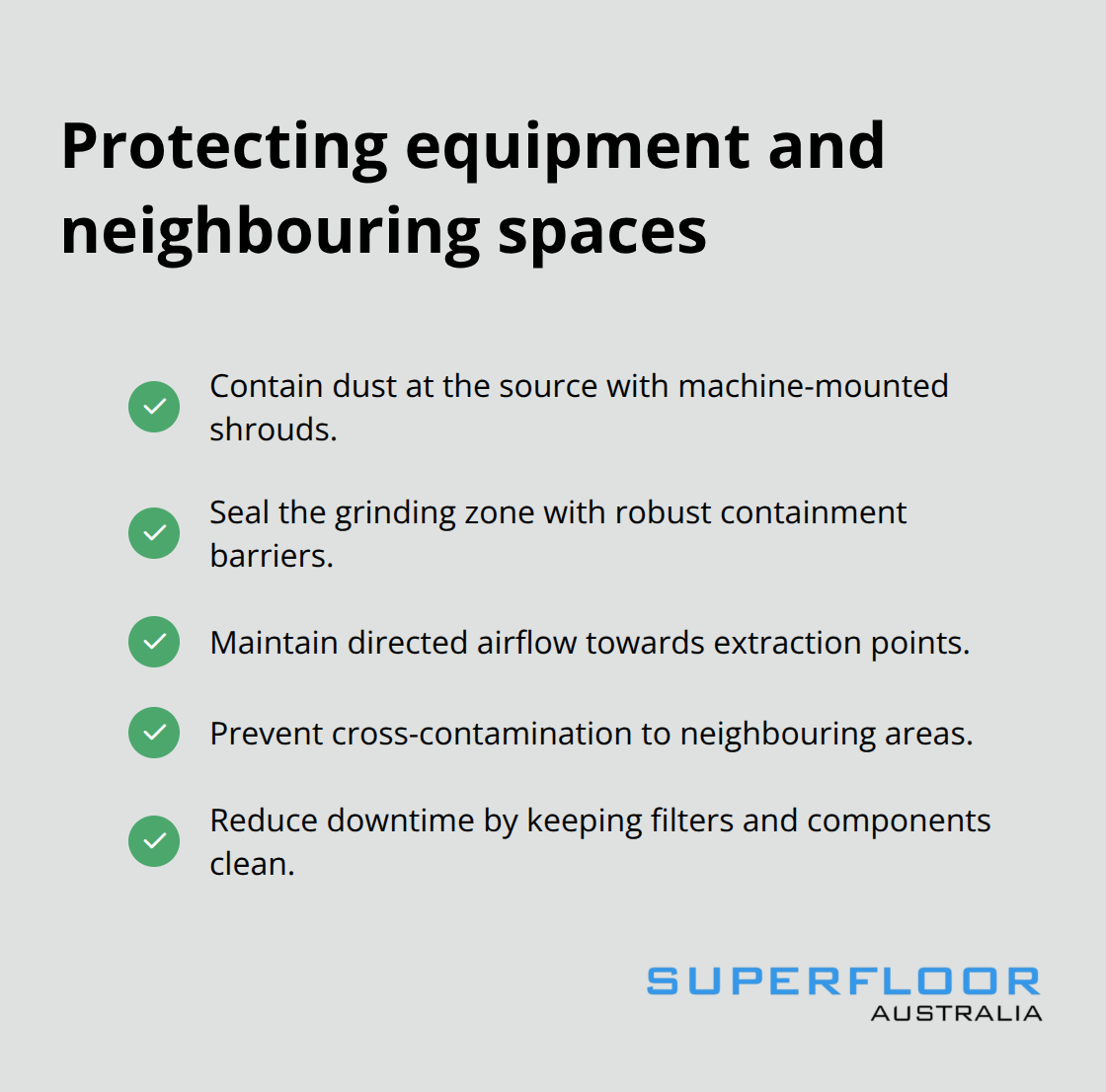
Concrete dust damages surrounding equipment and extends cleanup timelines significantly. Fine particles infiltrate electrical components, clog filters, and corrode metal surfaces when left unmanaged. Protecting nearby machinery means containing dust at the source rather than hoping ventilation alone solves the problem.
Dust shrouds attached directly to grinding machines capture particles immediately as they’re created, dramatically reducing what escapes into the air. For spaces adjacent to your grinding area-whether offices, retail zones, or residential rooms-dust barriers and sealed containment systems prevent cross-contamination. Without these precautions, you’ll spend days cleaning dust from surfaces that had no direct contact with the work. Property owners and adjacent businesses notice when dust settles on their spaces, creating liability concerns and potential disputes.
Professional grinding operations prioritise containment strategies that protect both the immediate work area and everything surrounding it. The right dust control approach prevents the project from creating problems for other operations or occupants nearby. With health risks, equipment damage, and cleanup costs all tied to poor dust management, the next step involves understanding which dust reduction techniques actually deliver results on Brisbane job sites.
Effective Dust Extraction Systems for Brisbane Grinding Projects
HEPA Filtration and Industrial Vacuum Technology
HEPA filtration paired with industrial-grade vacuum technology forms the backbone of effective dust control on Brisbane grinding sites. A HEPA filter captures particles as small as 0.3 microns, which means it traps the silica dust that causes respiratory damage before it enters the air. Most professional grinding machines operate with dust shrouds that channel particles directly into extraction units equipped with HEPA filters. The filtration efficiency matters tremendously-a standard shop vacuum captures only larger particles and allows fine dust to escape back into your workspace, whereas HEPA-filtered extractors remove up to 99.97% of airborne contaminants. You should pair your grinder with a dust extractor rated for at least 100 cubic feet per minute airflow to handle the volume of material your machine produces.
Wet Grinding Versus Dry Grinding Methods
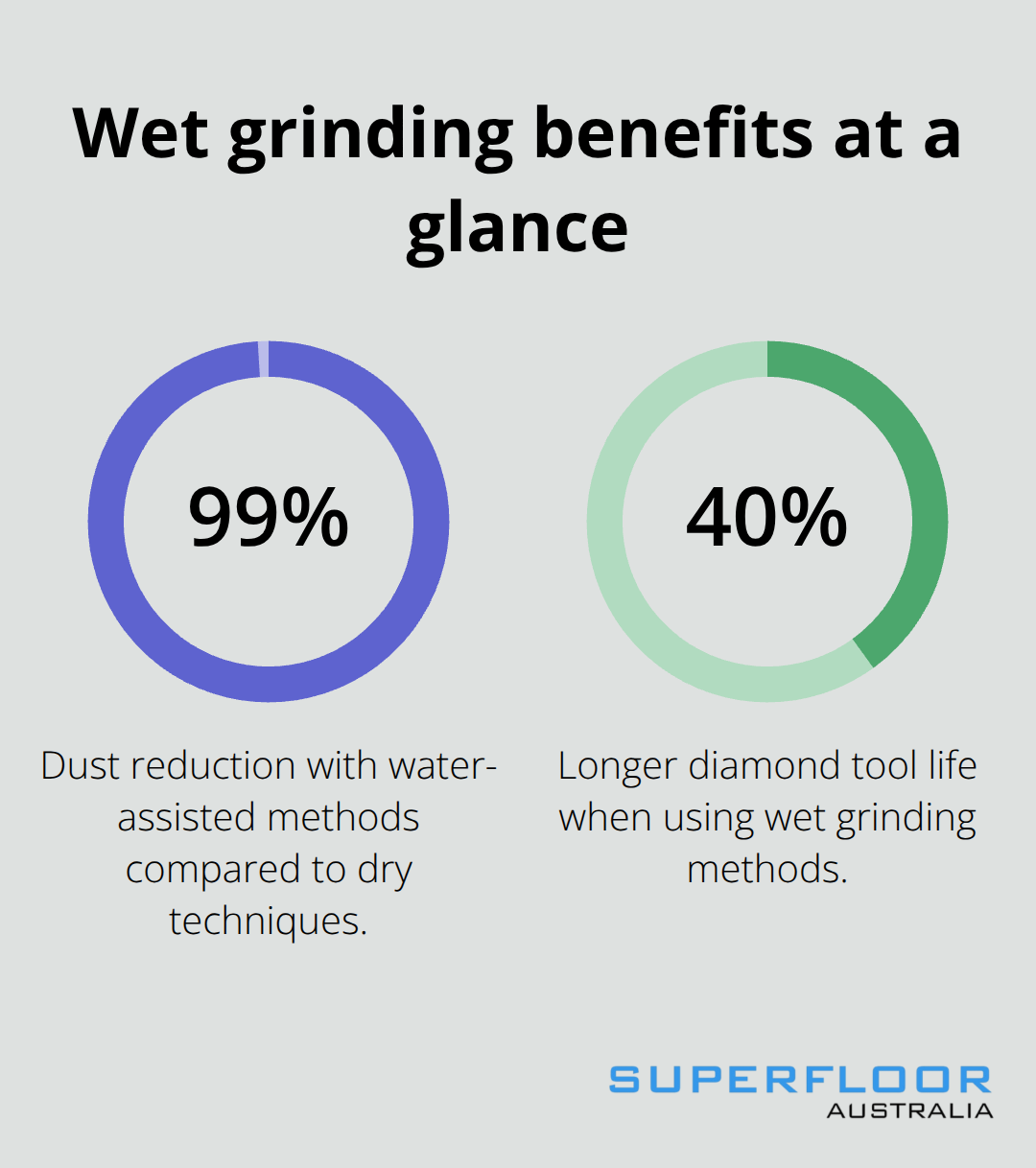
Wet grinding introduces water to cool the abrasive and suppress dust at the source, which significantly reduces airborne particles compared to dry methods. Water-assisted methods reduce dust production by 99% compared to dry techniques while they extend diamond tool life by 40%. The water weighs down dust particles so they settle rather than float, making wet grinding superior for indoor projects where air quality directly affects workers and occupants.
Dry grinding produces visible dust clouds but completes projects faster since there’s no drying time between grit stages. The choice between wet and dry depends on your site-outdoor spaces and large warehouses tolerate dry grinding better, while residential areas and commercial offices benefit from wet methods that keep dust contained.
Containment and Air Pressure Control
Negative air pressure systems create an invisible barrier that pulls air toward extraction points rather than allowing dust to drift into adjacent spaces. Strategic fan placement combined with sealed containment barriers prevents cross-contamination to neighbouring properties or office areas. These systems work most effectively when you seal the work zone properly and maintain consistent airflow throughout the project (typically 4–6 air changes per hour for enclosed spaces). Professional contractors in Brisbane recognise that dust management isn’t an afterthought-it’s integral to how the work gets scheduled and executed.
The technical side of dust control sets the foundation for precision finishing, but the real challenge lies in selecting the right abrasive tools and preparing your concrete surface properly to achieve the flawless results your project demands.
Achieving Precision Finishing Results
Precision finishing starts with selecting diamond abrasives matched to concrete condition. Coarse grits remove thick coatings, paint, and adhesive residues quickly, while medium grits smooth the surface and eliminate scratches from earlier stages. Fine grits (200–400) create the polished appearance that defines high-end finishes. The progression matters intensely-skipping grit stages leaves visible scratches that finer abrasives cannot remove, forcing you to restart with coarser diamonds and wasting time and material.
Start with a grit one level coarser than you think necessary because most Brisbane contractors underestimate how much material their first pass removes. A Husqvarna PG 830 RC or similar heavy-duty machine with proper diamond tooling removes material across the entire project, which means your first pass with coarser diamonds eliminates surface irregularities quickly without over-grinding. Move to the next finer grit only after confirming the previous stage has created a uniform surface across the entire area-inconsistent grinding at any stage compounds into visible defects in your final finish.
The concrete’s aggregate exposure depends on grit selection. If you want full aggregate exposure for a terrazzo-like appearance, continue progressing through finer grits beyond 400. If you prefer a honed finish with minimal aggregate, stop at 120–200 grit. Budget typically ranges from 50–65 dollars per square metre for polished concrete, with grit progression and equipment quality driving costs within that range.
Assessing Concrete Before You Start
Inspect your concrete thoroughly before grinding begins because hidden damage, moisture problems, or structural cracks determine whether standard grinding produces acceptable results or requires alternative approaches. Look for efflorescence (white powdery residue indicating moisture), hairline cracks, spalling, and areas where previous coatings failed to adhere fully.
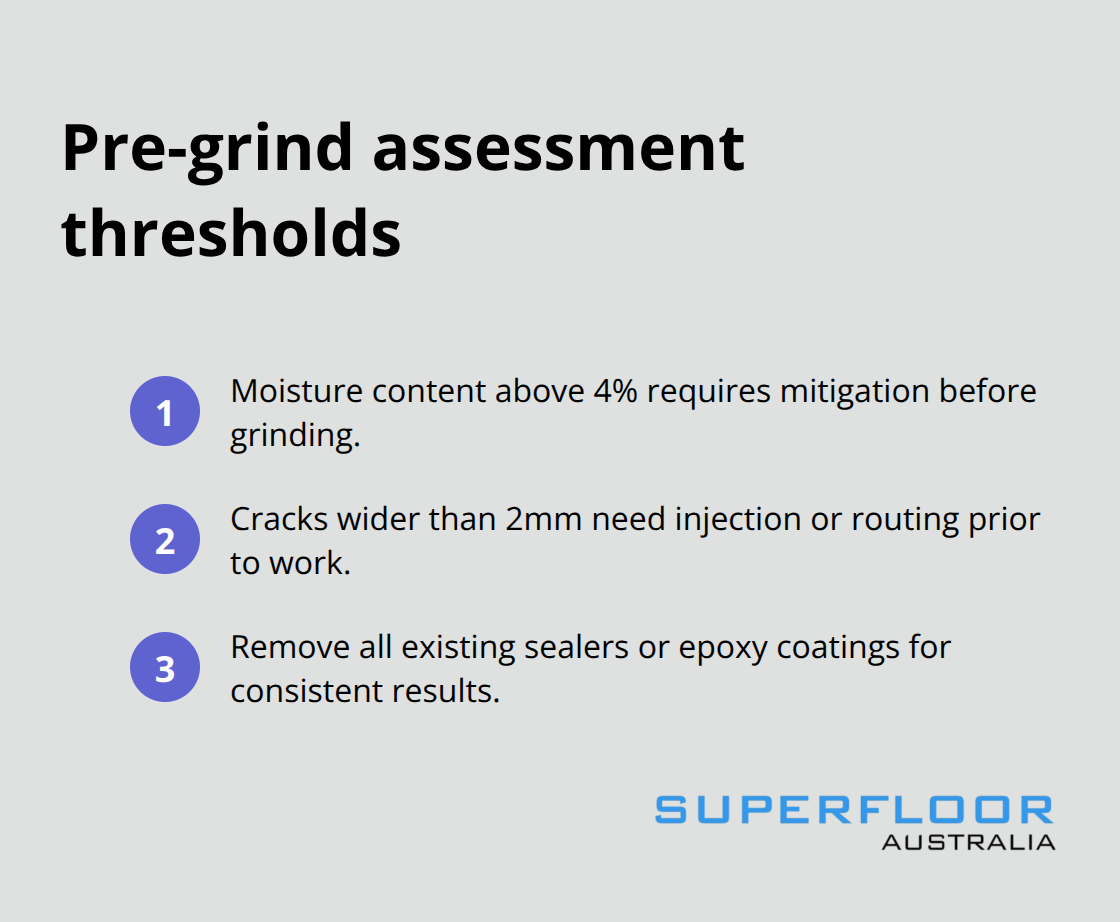
Moisture content exceeding 4 percent means water is rising through the slab and will continue affecting any finish you apply-this requires moisture mitigation before grinding proceeds. Cracks wider than 2mm typically indicate structural movement and need injection or routing before grinding, otherwise they’ll reappear visibly in your finished surface. Existing sealers or epoxy coatings must be completely removed because grinding over them creates uneven removal rates and inconsistent results.
Scarifying machines with rotating carbide-tipped flails handle thick coatings more aggressively than diamond grinding alone, reducing your overall timeline significantly. Once you’ve assessed the concrete’s actual condition, you can confidently select your grit sequence and predict realistic turnaround times. This preparation phase prevents the frustrating scenario where grinding produces a technically smooth surface that still reveals defects because the underlying concrete wasn’t properly evaluated first.
Inspecting Your Finished Surface
Final inspection requires comparing your completed surface against tangible standards rather than subjective preferences. Run your hand across the floor in multiple directions-a properly finished surface feels uniformly smooth without ridges, dips, or rough spots. Use a straightedge to check flatness across different zones, trying for variation no greater than 3mm over 3 metres, which is the standard tolerance for commercial installations.
Gloss level depends on your chosen finish, but it should be consistent across the entire area without dull patches or over-polished zones. Photograph your finished work under different lighting conditions because shadows reveal imperfections that overhead lights conceal. If you’re applying sealant after grinding, inspect the base surface under strong light before sealing-once sealant goes on, you cannot correct surface imperfections without starting the grinding process again.
Professional contractors in Brisbane schedule final inspection during daylight hours and with the client present so expectations align with what’s actually been delivered.
Final Thoughts
Dust control and precision finishing work together on Brisbane grinding projects-they’re not separate concerns but interconnected priorities that determine whether your concrete floor delivers lasting value or becomes a maintenance problem. HEPA filtration systems, wet grinding methods, and proper containment barriers protect your team while creating the clean work environment necessary for flawless finishes. Diamond abrasive selection, thorough surface assessment, and rigorous final inspection ensure your concrete meets commercial standards and performs reliably for years to come.
Professional expertise separates a technically smooth surface from a genuinely finished floor that enhances your space. Contractors with proven experience recognise that concrete condition varies across Brisbane sites-moisture issues, existing coatings, and structural cracks require tailored approaches rather than generic solutions. They invest in heavy-duty equipment paired with industrial dust extraction, understanding that cutting corners on either dust control or finishing precision creates problems that cost far more to correct than getting it right initially.
Our concrete grinding Brisbane tips emphasise that worker safety and surface quality go hand in hand. Contact Superfloor Australia to discuss your project and receive a detailed assessment of your concrete’s condition and finishing options.