

Most flooring projects in Brisbane fail before they even start. Poor surface preparation is the silent killer that undermines adhesion, durability, and the entire lifespan of your floor.
At Superfloor Australia, we’ve seen firsthand how Brisbane’s humidity and climate conditions demand specific prep techniques. The right Brisbane floor prep services make the difference between a floor that lasts decades and one that fails within years.
Why Floor Prep Determines Everything in Brisbane
Brisbane’s Climate Exposes Poor Preparation Fast
Brisbane’s climate creates conditions that expose poor preparation within months, not years. High humidity levels, substantial rainfall averaging 1,000mm annually, and temperature fluctuations between 10°C and 32°C force moisture deep into concrete and timber subfloors. When prep work skips moisture testing or surface cleaning, adhesives fail to bond properly, and flooring materials begin to separate from the base. Projects that ignore moisture readings above 4% according to AS 1884 standards often see tiles pop and vinyl buckle within weeks. The real cost isn’t the failed floor itself-it’s the emergency replacement, lost business time, and structural damage that follows.
Older Brisbane Slabs Demand Extended Preparation
Concrete slabs in older Brisbane properties built before 1990 present particular challenges because they often have higher water-cement ratios that require extended drying periods or moisture mitigation systems. Skipping this step adds 2-4 weeks of delays once problems surface, but addressing it upfront costs far less than repairs. Surface assessment reveals concrete condition, slab age, crack patterns, and contamination levels-information that determines both timeline and budget from the start.
Surface Condition Directly Affects Flooring Lifespan
Surface condition directly determines how long your flooring actually lasts. Polished concrete installations in Brisbane have become increasingly popular because property owners understand that a properly prepared slab lasts 20-30 years under heavy traffic, compared to carpet at 7 years or timber at 15 years. That durability only happens if the prep process removes oil stains, paint residues, and old adhesives-work that typically adds 2-3 days to the timeline but prevents delamination, gaps, and uneven wear later.
Equipment Quality and Contractor Experience Matter
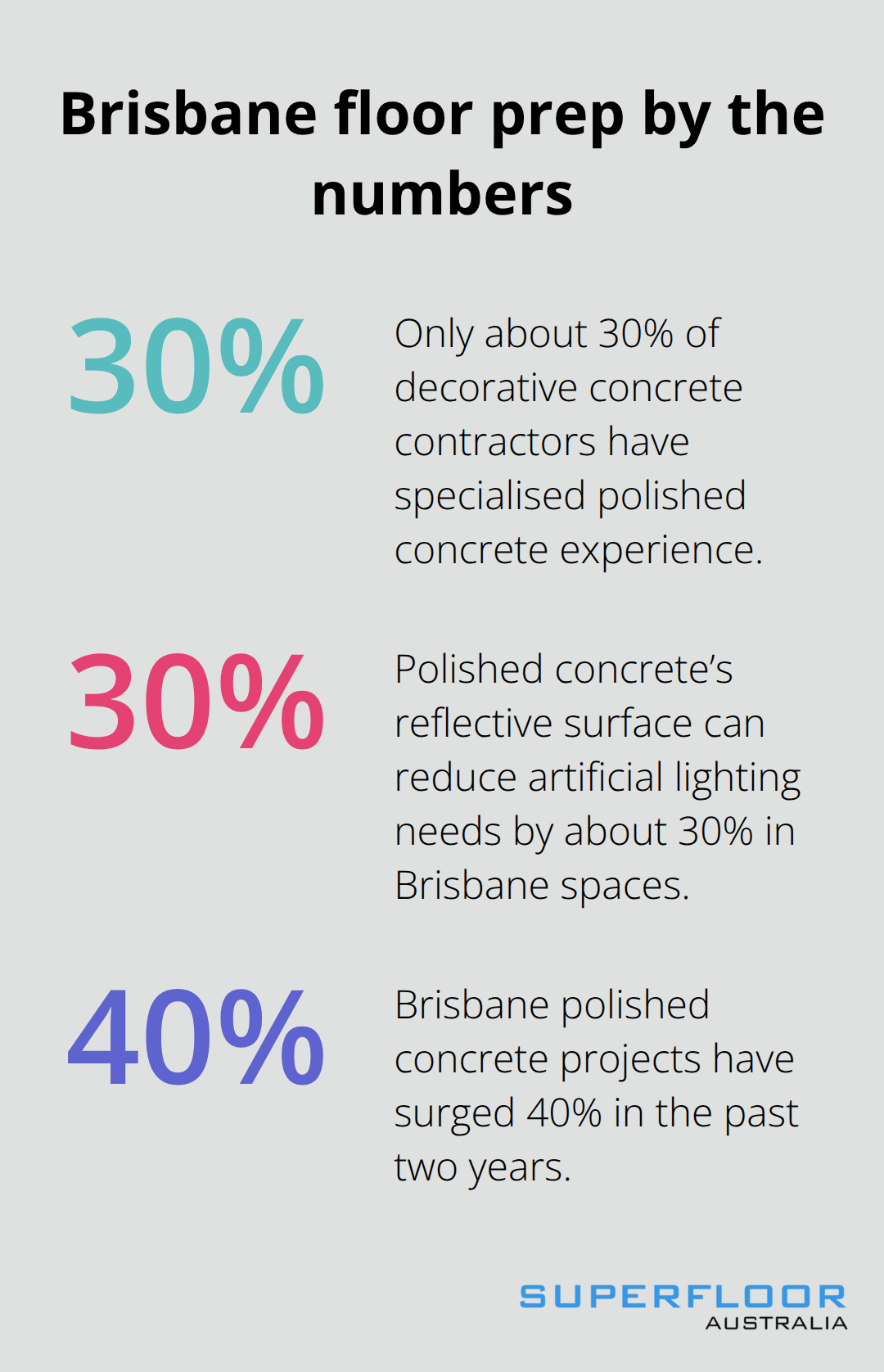
Professional-grade diamond polishing equipment costs $15,000-$25,000, and the quality of that equipment directly affects the finish and the prep foundation it creates. Adhesion fails when surfaces contain even small amounts of contamination, which is why thorough surface assessment before any work begins matters more than price alone. Only about 30% of decorative concrete contractors have specialised polished concrete experience, so verifying QBCC licensing and requesting recent project portfolios protects your investment.
Installation costs range from $3-$12 per square foot, but choosing a contractor with proper credentials and proven experience yields better long-term results.
Moisture Protection Requires Proper Densification and Sealing
Brisbane’s substantial rainfall means your floor’s non-porous surface must resist moisture intrusion, and that protection only works when prep includes proper densification and sealing applied to a genuinely clean base. The reflective surface of polished concrete can reduce artificial lighting needs by about 30%, cutting electricity bills in Brisbane spaces while the thermal mass moderates indoor temperatures and reduces cooling costs during summer months. When you’re ready to select a floor prep service, understanding these preparation stages helps you ask the right questions and compare contractors effectively.
The Three Core Prep Techniques That Deliver Results in Brisbane
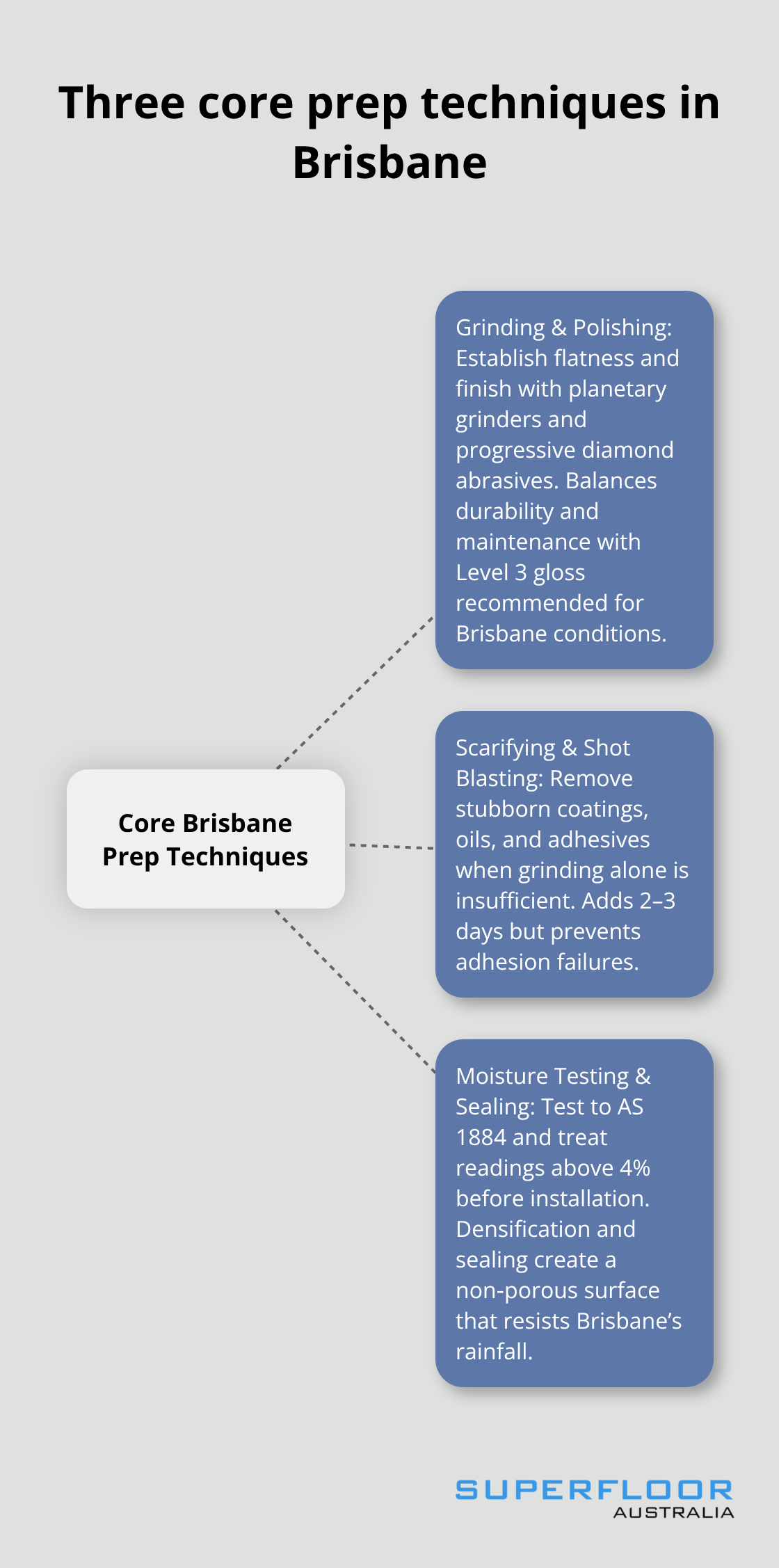
Concrete Grinding and Diamond Polishing Form the Foundation
Concrete grinding stands as the foundation of professional floor preparation across Brisbane, and the equipment quality determines everything about the outcome. Professional-grade planetary grinders with variable-speed systems adapt to different concrete hardness levels, improving efficiency while diamond segments with superior durability extend tool life on long projects. High-efficiency dust extraction systems keep worksites cleaner during grinding, and real-time blade temperature monitoring prevents overheating that degrades both equipment and the concrete surface.
Diamond polishing takes this further by using progressively finer diamond abrasives to achieve gloss levels 1 to 4, with Level 3 recommended for Brisbane’s climate because it balances durability with maintenance demands. Brisbane polished concrete projects have surged 40% in the past two years, driven by property owners recognising that a properly prepared and polished slab lasts 20-30 years under heavy traffic. Installation costs range from $3-$12 per square foot, but the real value emerges when you factor in maintenance costs of only $15-25 per square metre every 5-7 years compared to carpet replacement at $40-80 per square metre per decade.
The reflective surface reduces artificial lighting needs by approximately 30%, cutting electricity bills while thermal mass moderates indoor temperatures and reduces cooling costs during Brisbane summers. This combination of durability, low maintenance, and energy efficiency explains why polished concrete has become the preferred choice for Brisbane property owners seeking long-term flooring solutions.
Scarifying and Shot Blasting Attack Stubborn Contamination
Scarifying and shot blasting handle stubborn surfaces where standard grinding won’t cut through contamination or old coatings effectively. These methods add 2-3 days to your project timeline but prevent adhesion failures later. The aggressive action removes paint residues, oil stains, and adhesive remnants that would otherwise compromise your new flooring installation.
Laser-guided cutting technology enables millimetre-perfect cuts when structural adjustments are needed, enhancing safety while hydraulic systems cut through reinforced or high-density concrete on complex projects. A Gold Coast case study demonstrated the effectiveness of low-dust grinding with HEPA extraction combined with laser-guided cutting to limit disruption on sensitive sites. These advanced techniques protect both the work environment and the structural integrity of your property.
Moisture Testing and Sealing Protect Against Brisbane’s Climate
Moisture testing using calcium chloride tests or relative humidity assessments according to AS 1884 standards remains non-negotiable in Brisbane because readings above 4% create conditions where tiles pop, vinyl buckles, and adhesives fail within weeks. Densification and sealing applied to a genuinely clean base create the non-porous surface that resists Brisbane’s substantial rainfall averaging 1,000mm annually.
Professional contractors verify QBCC licensing and maintain recent project portfolios because only about 30% of decorative concrete contractors have specialised experience. Quotes with more than 40% price variance between contractors indicate inexperience or hidden costs, so insist on detailed breakdowns separating prep, materials, and labour components. This transparency protects your investment and sets realistic expectations for your project timeline and final results.
When you understand these three core techniques-grinding and polishing, scarifying and shot blasting, and moisture protection-you’re ready to evaluate which contractors can actually deliver on their promises.
How to Pick a Floor Prep Contractor That Won’t Waste Your Money
Match Contractor Experience to Your Specific Flooring Type
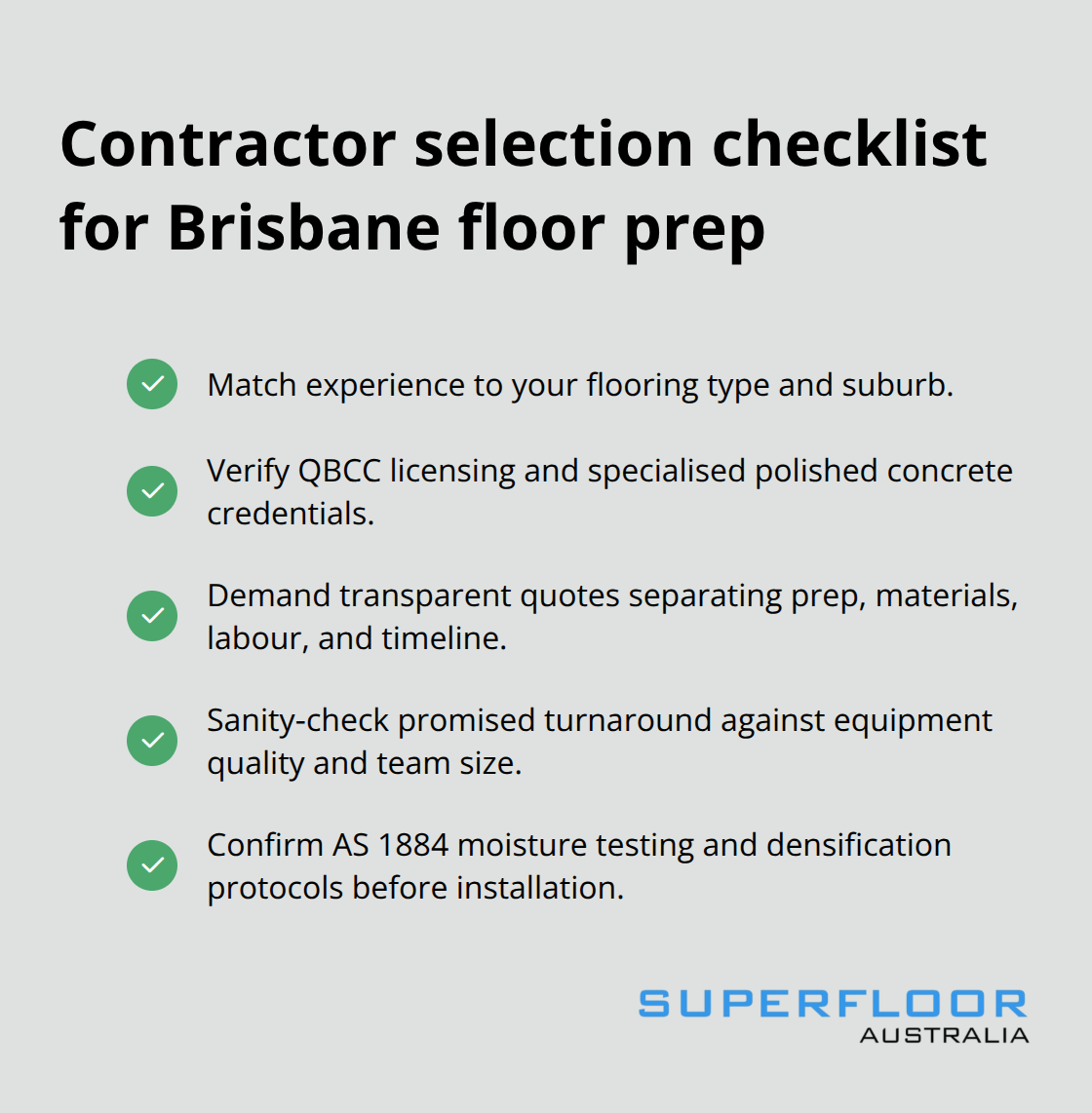
Start with your contractor’s experience directly aligned to your specific flooring type and Brisbane location. A contractor skilled in polished concrete may lack expertise in vinyl plank or hybrid flooring prep, where flatness tolerances shift significantly. Vinyl plank requires stricter tolerances than those indicated in Australian Standards. Ask potential contractors about recent projects matching your exact flooring material and glossy level preference in Brisbane suburbs similar to yours. Request project portfolios from the past 12 months, not generic examples from five years ago. A contractor who hesitates to provide recent work samples or references from comparable projects signals limited current experience with your specific needs.
Verify QBCC licensing for floor prep contractors Brisbane and Specialised Credentials
QBCC licensing is mandatory, but that credential alone does not guarantee specialisation. Only about 30% of decorative concrete contractors hold specialised polished concrete experience, so verify this distinction explicitly before comparing quotes. Temperature fluctuations between 10°C and 32°C in Brisbane, combined with 1,000mm annual rainfall, create unique prep demands that separate experienced local contractors from those treating Brisbane like any other Australian market. Ask contractors directly about their experience with Brisbane’s humidity levels and moisture challenges specific to your suburb.
Analyse Pricing Breakdowns and Reject Vague Quotes
Pricing variance exceeding 40% between contractors almost always indicates inexperience or hidden costs rather than genuine savings. Insist on written quotes that separate prep work, materials, labour, and timeline explicitly. A contractor quoting $3–$12 per square foot for installation without breaking down prep stages leaves you vulnerable to scope creep and surprise expenses. Transparent pricing protects your budget and sets realistic expectations from the start.
Evaluate Turnaround Times Against Equipment Quality
Turnaround time directly correlates with equipment quality and team size. Professional-grade planetary grinders with variable-speed systems and real-time blade temperature monitoring reduce timeline while improving results, but they represent significant capital investment that budget contractors often skip. Residential polished concrete projects typically require 4–6 days (1–2 days prep, 24-hour curing for densification, 2–3 days polishing, and 1 day sealing). If a contractor promises completion in 2–3 days, they cut corners on densification or rush the polishing stage, both of which compromise durability.
Confirm Moisture testing according to AS 1884 standards and Densification Protocols
Moisture testing cannot be rushed; readings above 4% require extended drying periods or moisture mitigation systems that add 2–4 weeks legitimately. A contractor who omits moisture testing from their quote gambles with your project’s long-term success. Proper densification and sealing applied to a genuinely clean base create the non-porous surface that resists Brisbane’s substantial rainfall. Ask contractors to explain their moisture assessment process and how they address readings above the 4% threshold before proceeding with installation.
Final Thoughts
Proper floor preparation determines whether your Brisbane flooring investment lasts decades or fails within years. The techniques, moisture protocols, and contractor credentials throughout this guide separate successful projects from costly mistakes. Brisbane’s climate, older concrete slabs, and contamination challenges demand specific expertise that generic floor prep services cannot match.
We at Superfloor Australia handle every preparation stage with precision and attention to detail. Our team understands Brisbane’s humidity, rainfall patterns, and temperature fluctuations that expose poor prep work within months. We apply professional-grade equipment, verify moisture readings against AS 1884 standards, and execute densification and sealing protocols that create genuinely durable surfaces. Whether your project requires polished concrete, concrete honing, or outdoor honed solutions for slip-resistant elegance, our Brisbane floor prep services combine expert craftsmanship with tailored solutions matched to your specific needs.
Contact Superfloor Australia to discuss your flooring goals and receive a detailed quote that separates prep work, materials, and labour transparently. Request recent project portfolios from Brisbane suburbs matching your location, verify our QBCC licensing, and ask directly about our moisture testing protocols and densification approach. The contractors who hesitate to answer these questions aren’t worth your time or money.