

Industrial floors take a beating. Heavy machinery, constant foot traffic, and chemical spills demand finishes that can handle the punishment without cracking, staining, or becoming a slip hazard.
At superfloor australia, we’ve seen firsthand how the wrong industrial floor finishing choice costs businesses thousands in repairs and downtime. The right solution protects your investment and keeps your team safe.
Why Specialised Finishes Matter in Heavy Industry
Industrial floors fail for three specific reasons: they cannot handle the load, they absorb what spills on them, or they become hazardous underfoot. Forklifts weigh up to 5,000 kilograms and concentrate that force onto small contact points. Standard concrete cracks under repeated impact because it lacks the flexibility and surface hardness that specialised coatings provide. When machinery vibrates continuously, unprotected concrete develops micro-fractures that spread into larger damage within months. Chemical spills penetrate bare concrete within hours, leaving permanent stains and weakening the substrate from inside out. The Industrial Floor Coating Market was valued at USD 5.42 billion in 2024 and is forecast to reach USD 10.62 billion by 2035, expanding at a CAGR of 6.3%-a clear signal that facilities recognise the true cost of choosing the wrong finish. Manufacturing plants, food processing facilities, and distribution centres cannot afford downtime from floor failure. A single day of production stoppage costs thousands in lost output, not counting the expense of emergency repairs and worker safety incidents.
Load-Bearing Demands Drive Coating Selection
Epoxy coatings bond directly to concrete and distribute heavy loads across a wider surface area, preventing the localised crushing that destroys bare concrete under forklift traffic. Polyurethane cement, the toughest option available, withstands thermal shock and vibration without cracking, making it ideal for cold storage and food processing where temperature swings exceed 30 degrees Celsius daily. Self-levelling epoxy fills surface irregularities to create seamless protection, eliminating the cracks and crevices where moisture penetrates and damage begins. The difference between adequate and inadequate finishes shows up within the first year: cracked, stained floors signal that the system was undersized for the facility’s actual demands.
Chemical Resistance and Contamination Control
Bare concrete is porous and absorbs oils, solvents, and aggressive cleaners that stain permanently and degrade the surface. Polyurethane cement resists both thermal shock and chemical assault, remaining intact even when exposed to steam cleaning and food-grade sanitizers. Epoxy creates an impervious barrier that prevents spills from penetrating, making cleanup immediate and preventing bacteria harborage in porous surfaces. Food processing facilities demand seamless, non-porous finishes because bacteria hide in cracks and crevices; polyurethane cement meets HACCP certification standards and supports steam-clean operations without deteriorating. Facilities handling petroleum products or solvents need solvent-borne epoxy rather than water-borne alternatives because water-based systems lack the tolerance to petroleum contaminants that protect against staining and degradation.
Slip Risk and Worker Safety
Australian standards require slip resistance ratings from R9 to R13 depending on the hazard level and floor conditions. Wet environments demand P5 non-slip finishes; dry warehouses can function with P3 ratings. Integrated safety line marking in slip-resistant coatings improves site compliance and reduces hazard exposure across high-risk zones. A worker injured from a slip on an inadequately finished floor creates liability claims and lost productivity that far exceed the cost of proper finishing from the start. Your facility’s specific demands-the equipment weight, chemical exposure, temperature fluctuations, and traffic patterns-determine which finish will actually protect your investment and your team.
Which Finish Works Best for Your Industrial Demands
Epoxy Coatings: The Workhorse for Most Industrial Facilities
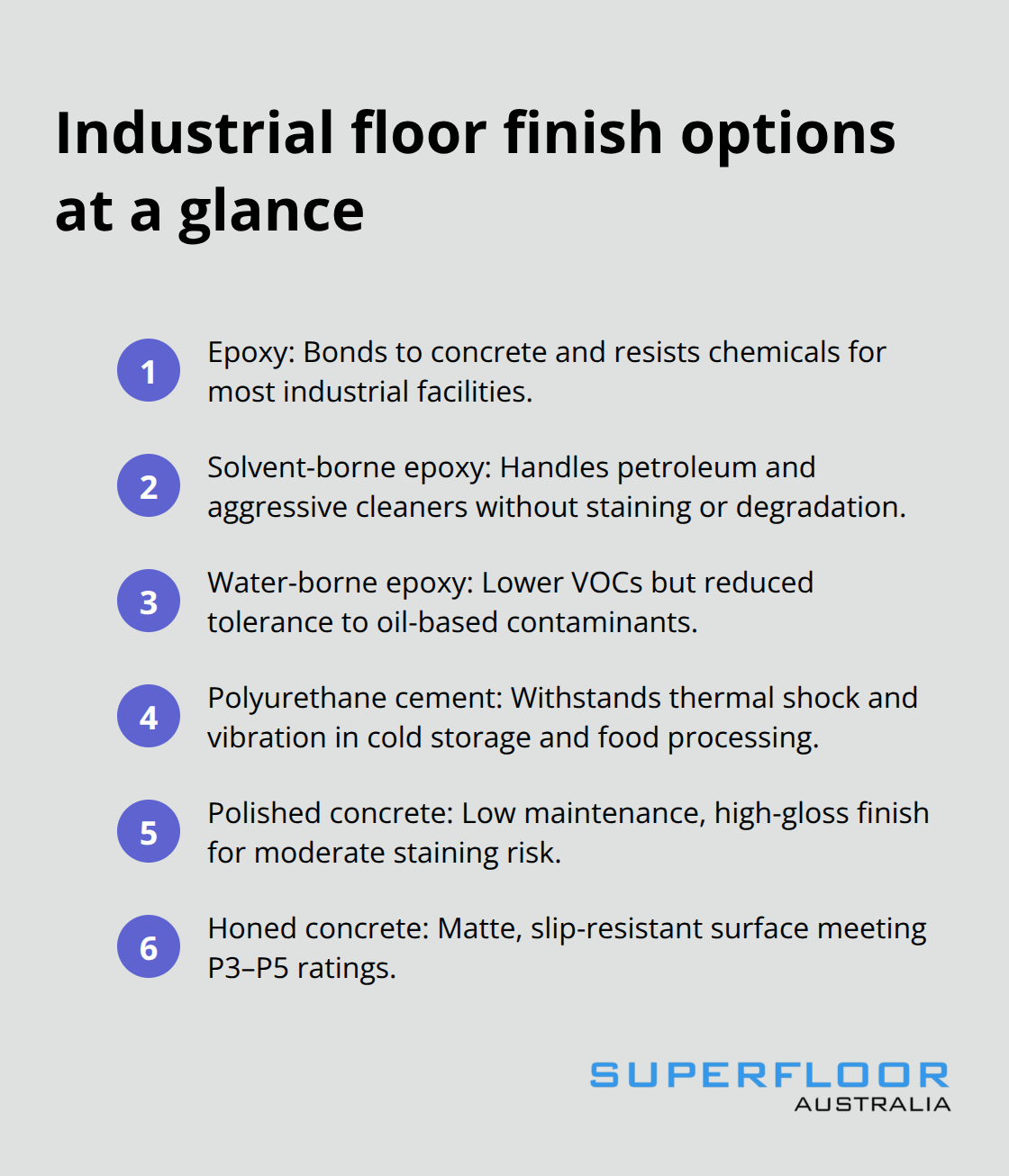
Epoxy coatings bond directly to concrete and resist chemicals that destroy bare surfaces, handling the impact loads that crack unprotected slabs. A facility using solvent-borne epoxy withstands petroleum spills, solvents, and aggressive cleaners without staining or degradation, whereas water-borne epoxy sacrifices durability against oil-based contaminants to reduce VOC emissions. Your actual chemical exposure determines which option protects your floor. Epoxy fills surface irregularities to create seamless protection, eliminating cracks and crevices where moisture penetrates and bacteria hide. The global industrial floor coating market reached USD 5.42 billion in 2024 and continues expanding because facility managers recognise that undersized finishes fail within months, whereas properly specified epoxy systems protect investments for 10 to 15 years.
Polyurethane Cement: The Premium Choice for Extreme Conditions
Polyurethane cement outperforms standard epoxy in extreme conditions, particularly cold storage and food processing where temperature swings exceed 30 degrees Celsius daily without causing the micro-fractures that destroy standard epoxy. This material meets HACCP certification and supports steam cleaning at high temperatures, making it non-negotiable for facilities requiring hygienic operations. Polyurethane cement resists both thermal shock and chemical assault, remaining intact even when exposed to aggressive cleaners and food-grade sanitizers. The flexibility that polyurethane cement delivers prevents cracking under continuous machinery vibration, a critical advantage in facilities where equipment runs 24/7.
Polished and Honed Concrete: Aesthetics Meets Function
Polished concrete offers a sleek, high-gloss finish that reduces dust and allergens, suiting low-maintenance environments where staining risk is moderate. Honed concrete provides slip resistance without the glossy appearance, delivering a matte surface that meets P3 to P5 non-slip ratings depending on aggregate exposure and finish depth. Both options work well in distribution centres and light industrial spaces where aesthetic appeal matters alongside durability.
Matching Your Finish to Actual Operating Conditions
Your specific selection hinges on load weight, chemical exposure, temperature fluctuations, and slip hazard. Forklifts concentrating loads onto small contact points demand the load distribution that epoxy or polyurethane cement provides. Continuous machinery vibration requires flexibility that polyurethane cement delivers without cracking. Wet environments with food processing or petroleum handling demand seamless, non-porous finishes because bare concrete absorbs contaminants within hours, creating permanent stains and structural weakness. The mistake most facilities make is treating floor finishing as a cost centre rather than a risk mitigation decision. Choosing epoxy over polyurethane cement when thermal shock occurs leads to cracking within the first year and emergency replacement costs that exceed the initial premium by 300 percent. Identifying your facility’s true demands-not just today’s operations, but the equipment and chemicals you’ll introduce over the next decade-shapes whether your floor investment lasts 15 years or fails in one.
Matching Your Facility’s Actual Operating Profile
Document Equipment Loads and Traffic Patterns
Your industrial floor finish must match what actually happens on your concrete every single day. Start by recording the specific loads your facility handles: forklifts and pallet jacks concentrate force onto small contact points, creating ground pressure that must be evaluated against your floor structure. Measure the weight of your heaviest equipment and note how many hours daily it operates on the same floor zones. Traffic patterns reveal where your finish takes the most punishment-identify high-traffic zones and separate them from low-traffic areas, because oversizing the entire floor wastes budget while undersizing high-impact zones guarantees early failure.
Catalog Chemical Exposure and Temperature Demands
Next, list every chemical your facility introduces: petroleum products, solvents, food-grade sanitizers, steam, or aggressive alkaline cleaners all demand different coating chemistry. A facility using water-based cleaners can tolerate water-borne epoxy, but one handling petroleum spills absolutely requires solvent-borne epoxy because these coatings withstand exposure to acids, alkalis, solvents, oils, and petroleum products without degrading or staining. Temperature fluctuations matter far more than most facility managers realise: food processing plants and cold storage facilities experience significant temperature swings daily, which causes standard epoxy to micro-fracture within months, whereas polyurethane cement flexes without cracking under continuous thermal shock. Document your facility’s minimum and maximum operating temperatures over a full year cycle to match your coating selection to actual conditions.
Calculate Total Maintenance Costs Over Time
Maintenance costs separate cheap finishes from smart investments far more than installation price does. Solvent-borne epoxy costs roughly 15 to 25 percent more than water-borne alternatives upfront, but it eliminates the yellowing and chemical sensitivity that forces early replacement. Polyurethane cement costs 40 to 60 percent more than basic epoxy initially, yet a food processing facility spending thousands daily on cleaning and sanitisation recoups that premium within two years through reduced maintenance labour and extended floor life. Calculate your facility’s total annual maintenance budget (including cleaning chemicals, equipment downtime during repairs, and labour hours spent managing floor issues): a floor finish that costs 20 percent more upfront but reduces annual maintenance by 30 percent delivers a superior return.
Match Finish Type to Your Operating Conditions
Polished concrete requires minimal maintenance and suits distribution centres where staining risk remains moderate and aesthetic appeal supports customer-facing operations. Honed concrete provides slip resistance without glossy appearance, meeting P3 to P5 non-slip ratings depending on aggregate exposure and finishing depth, making it practical for warehouses balancing safety and durability. Choosing epoxy when polyurethane cement matches your operating conditions costs three times more in emergency replacement and lost production than paying the premium upfront. Your facility’s specific demands-the equipment weight, chemical exposure, temperature fluctuations, and traffic patterns-determine which finish will actually protect your investment and your team over the next decade.
Final Thoughts
Industrial floor finishing demands that you match your coating to what your facility actually does every day: the weight of equipment running across your concrete, the chemicals you introduce, the temperature swings you experience, and the slip hazards your team faces. Epoxy coatings work well for most industrial spaces because they bond directly to concrete and resist chemicals that destroy bare surfaces, but they fail under extreme thermal shock. Polyurethane cement costs more upfront yet outperforms standard epoxy in cold storage and food processing where temperature fluctuations exceed 30 degrees Celsius daily.
The mistake most facilities make is choosing based on installation price rather than total cost of ownership. A floor finish that costs 20 percent more initially but reduces annual maintenance by 30 percent delivers superior return over 10 to 15 years. Choosing the wrong system costs three times more in emergency replacement and lost production than paying the premium for the right solution upfront.
We at superfloor australia understand that industrial floor finishing requires precision and expertise tailored to your actual operating conditions. Our team specialises in polished concrete and concrete honing solutions that deliver durability alongside aesthetic appeal, with expert craftsmanship ensuring lasting results for commercial and industrial spaces. Contact us for a professional assessment of your facility’s specific demands and a recommendation that protects your investment and your team.