

Industrial floor prep in Brisbane isn’t optional-it’s the foundation of a safe, productive workspace. Poor surface conditions lead to equipment damage, worker injuries, and costly downtime that compounds over time.
At superfloor australia, we’ve seen firsthand how proper preparation transforms industrial facilities. The right approach protects your investment and keeps operations running smoothly.
Why Industrial Floor Prep Stops Workplace Injuries Before They Start
Industrial floor prep stops workplace injuries by providing consistent traction and stable surfaces for equipment. Uneven concrete surfaces and contaminated floors directly cause worker injuries in Brisbane’s industrial facilities. Tripping hazards from raised edges, cracks, or debris account for a significant portion of workplace accidents in warehouses and factories. When forklifts, pallet jacks, and heavy machinery operate on compromised surfaces, operators lose control faster and accident response times shrink.
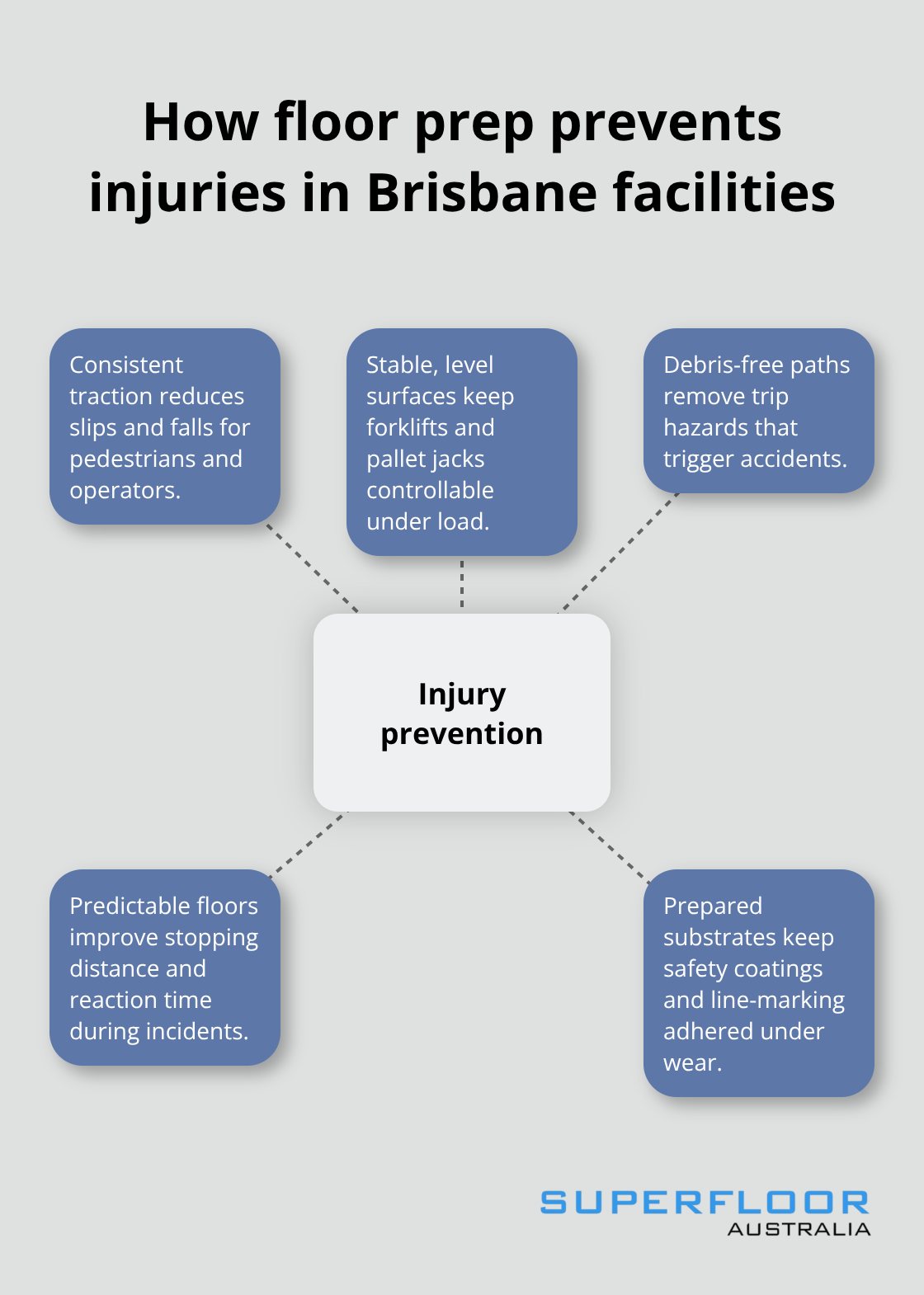
Oil residue, moisture, and loose coatings reduce traction dramatically. A worker moving at normal speed across a slippery floor can fall within seconds, resulting in fractures, head injuries, or worse. Facilities where floor conditions went overlooked experienced multiple incidents within months, forcing management to halt operations for emergency repairs. Properly prepared floors eliminate these risks entirely by providing consistent traction, stable surfaces for equipment, and no hidden hazards.
The cost of a single serious workplace injury-medical expenses, workers compensation claims, and lost productivity-exceeds the investment in professional floor preparation by multiples.
Equipment Fails Faster on Poor Surfaces
Machinery vibrates excessively and wears prematurely when operating on uneven, unprepared concrete. Equipment lifespan on uneven surfaces suffers when forklifts and pallet jacks develop hydraulic leaks and suspension damage because every bump transmits shock through mechanical systems. Precision equipment like CNC machinery or heavy production lines cannot maintain accuracy on floors with variations exceeding tolerance levels, leading to defective products and costly downtime.
A warehouse that skipped proper levelling experienced epoxy peeling within months, tripling repair costs and forcing complete re-preparation. Smooth, level floors extend equipment lifespan significantly and maintain operational precision.
Meeting Queensland Building Codes and Industrial Standards
Australian industrial standards require floors to meet specific flatness tolerances and surface profiles before machinery installation. Queensland building codes mandate moisture testing on concrete substrates before applying coatings. Calcium chloride moisture tests must show moisture content not more than 5.5% to prevent coating failure and delamination.
Facilities operating without compliant preparation risk regulatory fines, failed inspections, and liability exposure if incidents occur. Proper floor preparation documentation demonstrates compliance during audits and protects your facility legally. Professional preparation services handle all testing, repair, and certification requirements, eliminating guesswork and regulatory risk for your operation.
These three factors-worker safety, equipment protection, and regulatory compliance-form the foundation of why floor preparation matters. The next section examines the specific techniques that address each of these concerns and deliver results across Brisbane’s industrial landscape.
How to Prepare Industrial Floors Correctly
Grinding and Levelling: The Foundation of Floor Prep
Concrete grinding and levelling form the backbone of any serious floor preparation project in Brisbane’s industrial sector. Surface irregularities exceeding 3mm across a 2-metre span cause premature equipment wear and coating failure. Low-speed floor grinders handle minor surface imperfections and brittle mortar buildup, but significant material deposits, rubber-based adhesives, or uneven slab levels demand high-speed grinding equipment like a meteor floor grinder. The meteor grinder functions as an industry standard for concrete grinding because it removes paint, epoxy coatings, and debris while grinding right up to vertical walls, enabling complete edge-to-edge preparation that eliminates patching requirements later. For tight corners and edges where full-size grinders cannot reach, a handheld 125mm surface grinder completes the job.
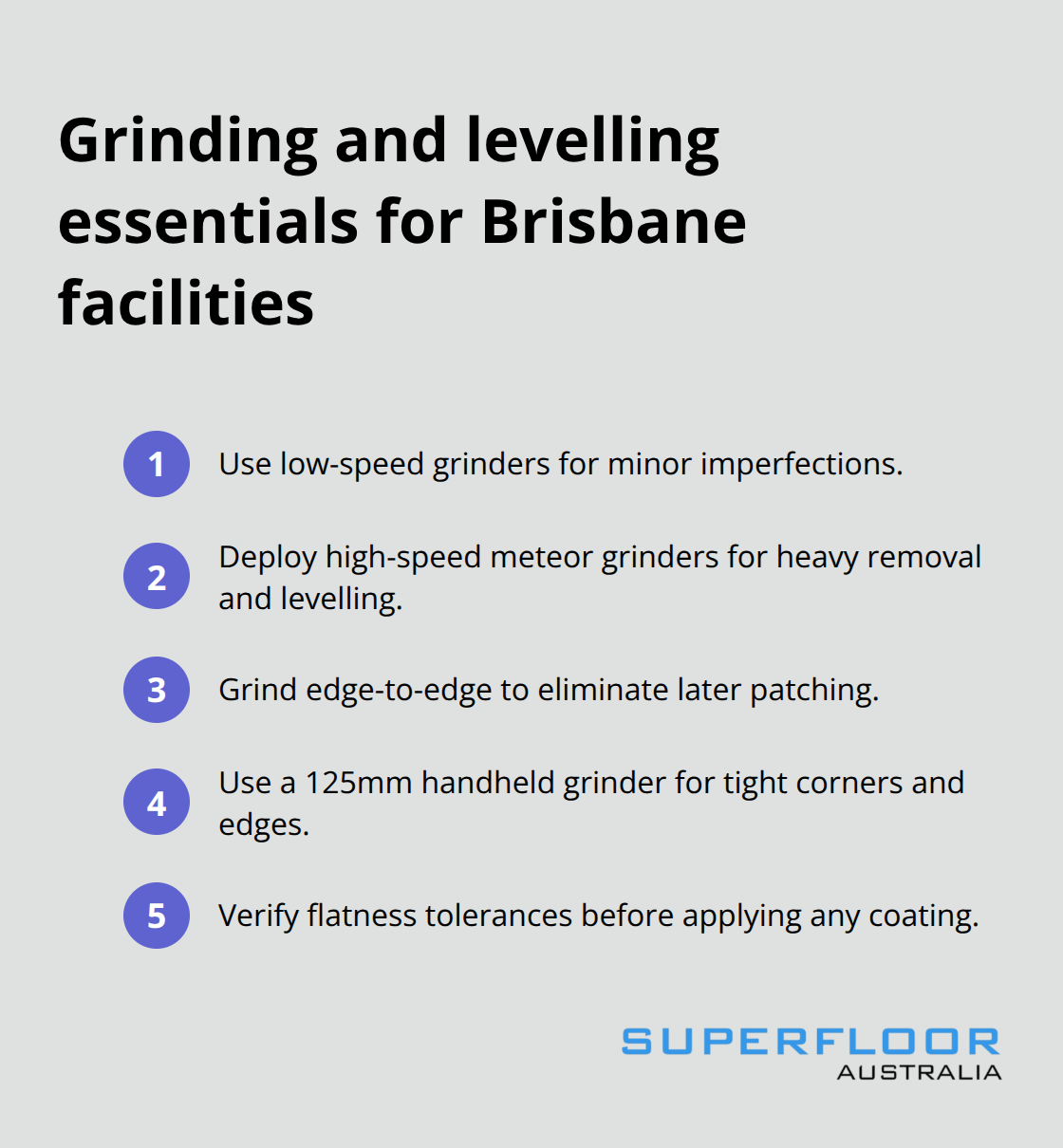
After grinding, the concrete surface must measure within acceptable flatness tolerances before any coating application occurs.
Removing Contamination and Preparing the Substrate
Surface contamination directly sabotages coating adhesion and operational safety on industrial floors. Oil residue, grease, dust, and loose particles create weak bonding points where epoxy or other coatings fail to adhere properly, leading to delamination within months. Degreasing must occur before any etching or grinding to prevent fish eyes and poor adhesion; this step cannot be skipped regardless of surface condition. After degreasing and grinding, thorough vacuuming removes all dust particles so the substrate accepts coatings uniformly.
Managing Moisture and Curing Requirements
Moisture testing using calcium chloride methods determines whether the concrete substrate requires additional drying or vapour barriers before coating application. Brisbane’s humid climate makes moisture management non-negotiable for industrial facilities. New concrete requires at least 28 days of curing before any coating application, and the top layer containing sealants and laitance must be removed through grinding or shot blasting to open pores for proper adhesion. Existing cracks and spalls demand repair with two-part epoxy fillers like Sikadur 33 to restore substrate uniformity and prevent weak points under heavy machinery operation.
Tailoring Prep Methods to Your Floor’s Condition
Different industrial floors present different challenges that require customised preparation approaches. A warehouse that skipped proper levelling experienced epoxy peeling within months, tripling repair costs and forcing complete re-preparation. Smooth, level floors extend equipment lifespan significantly and maintain operational precision. The specific techniques you apply depend on whether you’re working with new concrete, previously coated surfaces, or floors showing signs of damage and wear. Professional floor preparation services assess your facility’s unique conditions and select the right combination of grinding, degreasing, moisture testing, and repair methods to deliver lasting results. Your next step involves selecting a preparation partner who understands Brisbane’s industrial environment and can execute these techniques with precision.
Choosing the Right Floor Preparation Partner in Brisbane
Finding the right floor preparation contractor in Brisbane demands more than a quick online search and the lowest quote. Industrial facilities operate on tight margins where floor downtime costs thousands per hour, so selecting a partner with genuine industrial experience separates successful projects from expensive failures.
Industrial Experience Sets Contractors Apart
A contractor who understands industrial applications knows that a warehouse floor differs fundamentally from a retail space. Equipment weight, chemical exposure, moisture levels, and traffic patterns all demand different preparation strategies. When you evaluate potential partners, ask directly about their experience with facilities similar to yours. Request references from warehouse managers, factory supervisors, or facility directors who can speak to actual results. A contractor claiming expertise across residential, commercial, and industrial work simultaneously should raise concerns because industrial floor preparation requires specialised knowledge of machinery requirements, regulatory compliance, and heavy-use durability that differs entirely from other applications.
Equipment and Technical Capability Matter
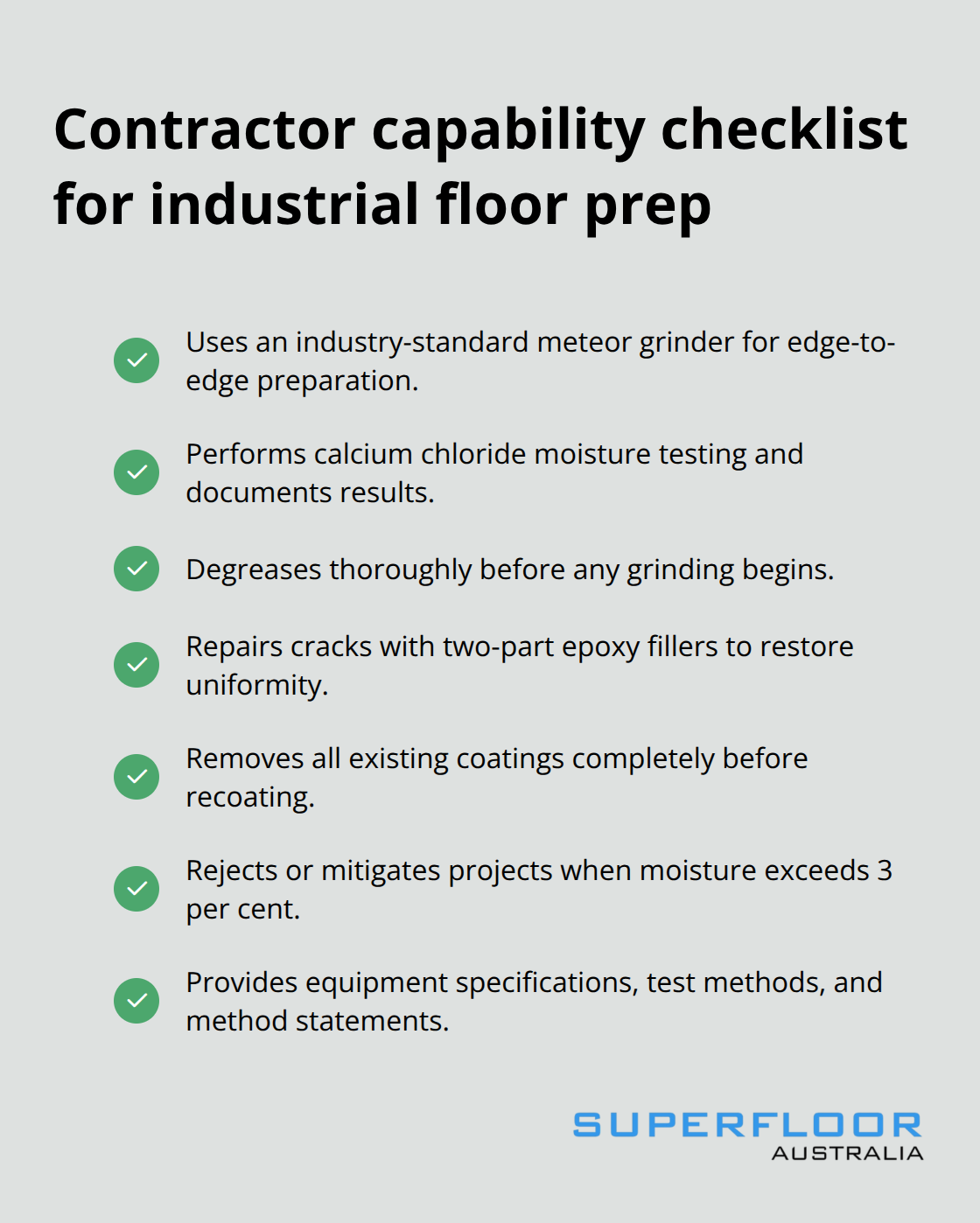
Quality of workmanship separates contractors who deliver lasting results from those who cut corners and leave you with premature coating failure. The meteor floor grinder represents the industry standard for concrete grinding because it enables edge-to-edge preparation without patching, but not all contractors invest in premium equipment or possess the skill to operate it effectively. Ask potential contractors about their equipment specifications, their approach to moisture testing using calcium chloride methods, and how they handle crack repair with two-part epoxy fillers. Contractors who skip degreasing before grinding, who ignore moisture content above 3 per cent, or who fail to remove old coatings completely will deliver floors that fail within months.
Attention to Detail Reveals True Professionalism
A contractor’s attention to detail appears in their willingness to assess your floor’s unique conditions thoroughly before recommending specific techniques. Some floors require shot blasting to remove ingrained contamination, others need grinding for levelling, and many demand both. A quality contractor evaluates surface condition, tests moisture, identifies cracks and spalls, and proposes a customised preparation plan rather than applying a one-size-fits-all approach to every project. The warehouse example mentioned earlier-where epoxy peeling occurred within months and repair costs tripled-typically results from contractors rushing through preparation steps to reduce labour costs (a mistake that costs far more in the long run).
Customized Solutions for Your Facility
Your industrial facility presents unique challenges that demand tailored preparation strategies. A contractor who listens to your operational requirements, understands your equipment specifications, and assesses your floor’s actual condition will recommend the right combination of techniques. This approach protects your investment and prevents the costly failures that occur when contractors apply generic solutions to specific problems.
Final Thoughts
Professional floor preparation transforms industrial facilities by protecting equipment from premature wear, eliminating workplace hazards that cause injuries, and meeting regulatory requirements without compromise. Industrial floor prep Brisbane addresses the specific challenges your facility faces-humidity, heavy traffic, and Queensland building code compliance all demand preparation methods tailored to your actual conditions rather than generic approaches that fail under real-world stress. Facilities that skip this step face epoxy failure within months, equipment breakdowns that halt production, and safety incidents that cost multiples of what proper preparation would have cost upfront.
Operational success rests on foundations that work reliably under pressure. A well-prepared floor supports your machinery, protects your workforce, and keeps downtime minimal so your business runs at full capacity. The techniques covered in this guide-grinding, degreasing, moisture testing, and crack repair-address the specific challenges Brisbane’s industrial environment presents.
We at superfloor australia deliver high-quality concrete flooring solutions tailored to industrial spaces, combining precision preparation with expert craftsmanship to ensure lasting results. Whether you’re preparing a new facility or restoring an existing floor, contact superfloor australia to discuss your industrial flooring needs and discover how proper preparation transforms your workspace into a safe, productive environment built to last.