

Polished concrete Brisbane costs vary wildly depending on what your space needs. The difference between a basic polish and a premium finish can easily add thousands to your project budget.
At superfloor australia, we’ve helped hundreds of Brisbane property owners understand where their money actually goes. This guide breaks down the real costs so you can budget with confidence.
What Really Drives Polished Concrete Costs in Brisbane
Concrete Condition Sets Your Budget Foundation
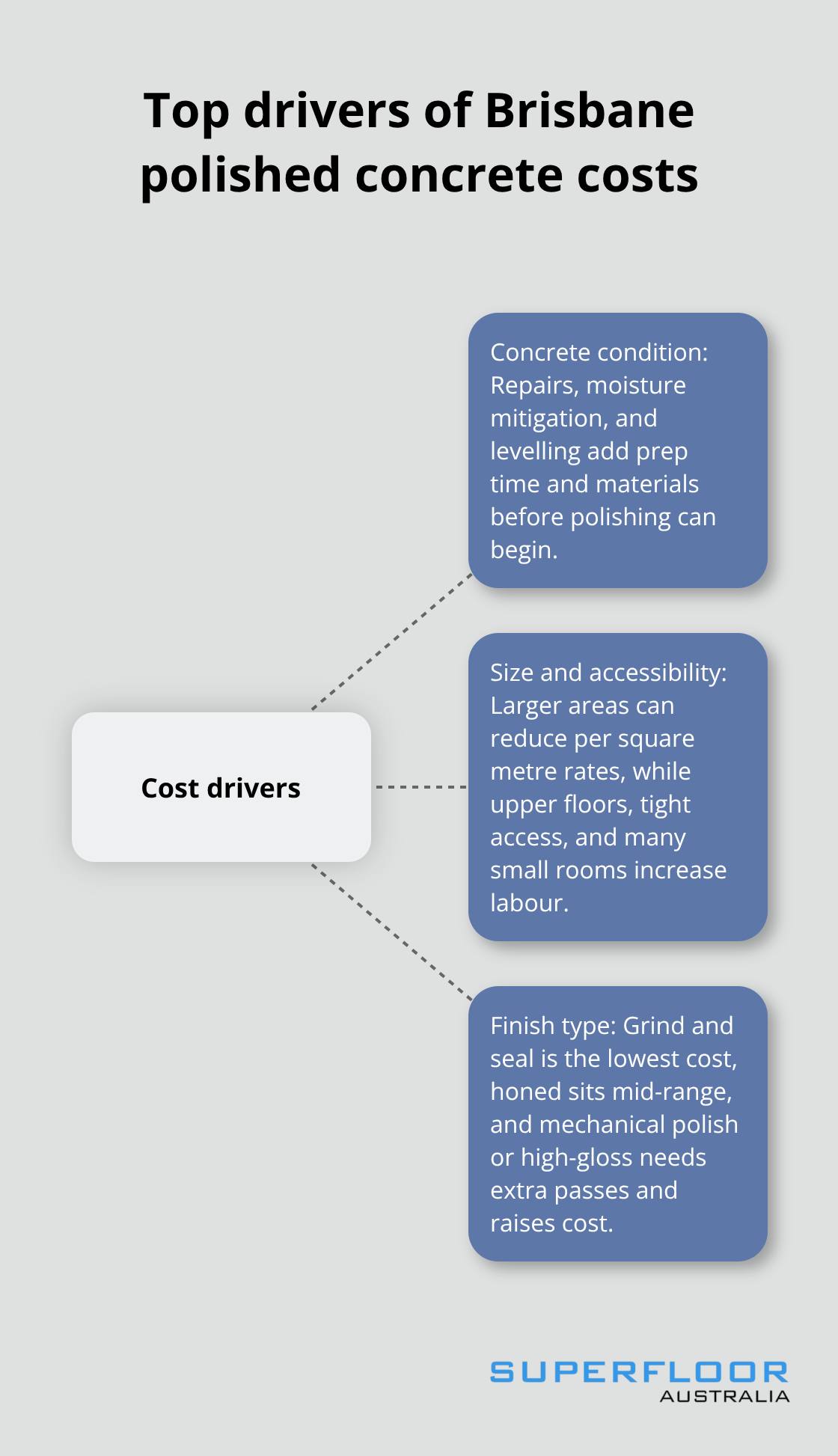
Your concrete’s current state will make or break your budget. A perfectly level, crack-free slab costs far less to polish than one needing repairs. Surface preparation adds costs when cracks, stains, or uneven sections require attention. Oil stains demand extra grinding passes. Deep scratches need filling. Uneven floors need levelling before polishing can even begin.
If your slab sits below ground level or has moisture issues, costs climb further. A site assessment reveals the true picture before you commit to a budget, because guessing on concrete condition leads to shock invoices later.
Project Size and Accessibility Impact Labour Costs
The size of your space matters more than most people realise. A 150 square metre home costs differently than a 50 square metre sunroom, and not just because one is three times larger. Smaller jobs under 50 square metres often use flat rates rather than per-square-metre pricing, sometimes running higher per unit. Mid-size residential areas between 100 and 200 square metres typically sit around $50 per square metre. Larger commercial projects over 500 square metres drop to $40 to $65 per square metre due to economies of scale.
Accessibility changes everything too. Ground-level floors with easy equipment access stay at standard rates. Upper floors, confined spaces, or layouts with multiple small rooms add labour costs because workers spend more time repositioning equipment and handling edge work. No three-phase power on site means generator hire, adding to your total. Difficult access locations incur surcharges just for transport and setup.
Finish Type Drives the Largest Cost Variation
Your finish choice determines the largest cost variation of all. Grind and seal runs around $50 per square metre and works well for budget-conscious projects. Honed concrete costs approximately $75 per square metre, delivering a sleek matte appearance with solid durability. Mechanically polished high-gloss finishes start at $100 per square metre and can exceed $150 per square metre for complex aggregate exposure.
Choosing high-gloss adds roughly $20 to $40 per square metre on top of matte options. Premium decorative finishes with exposed aggregates range from $80 to $120 per square metre. The gloss level you select directly impacts labour time and material costs because higher shine requires additional polishing passes.
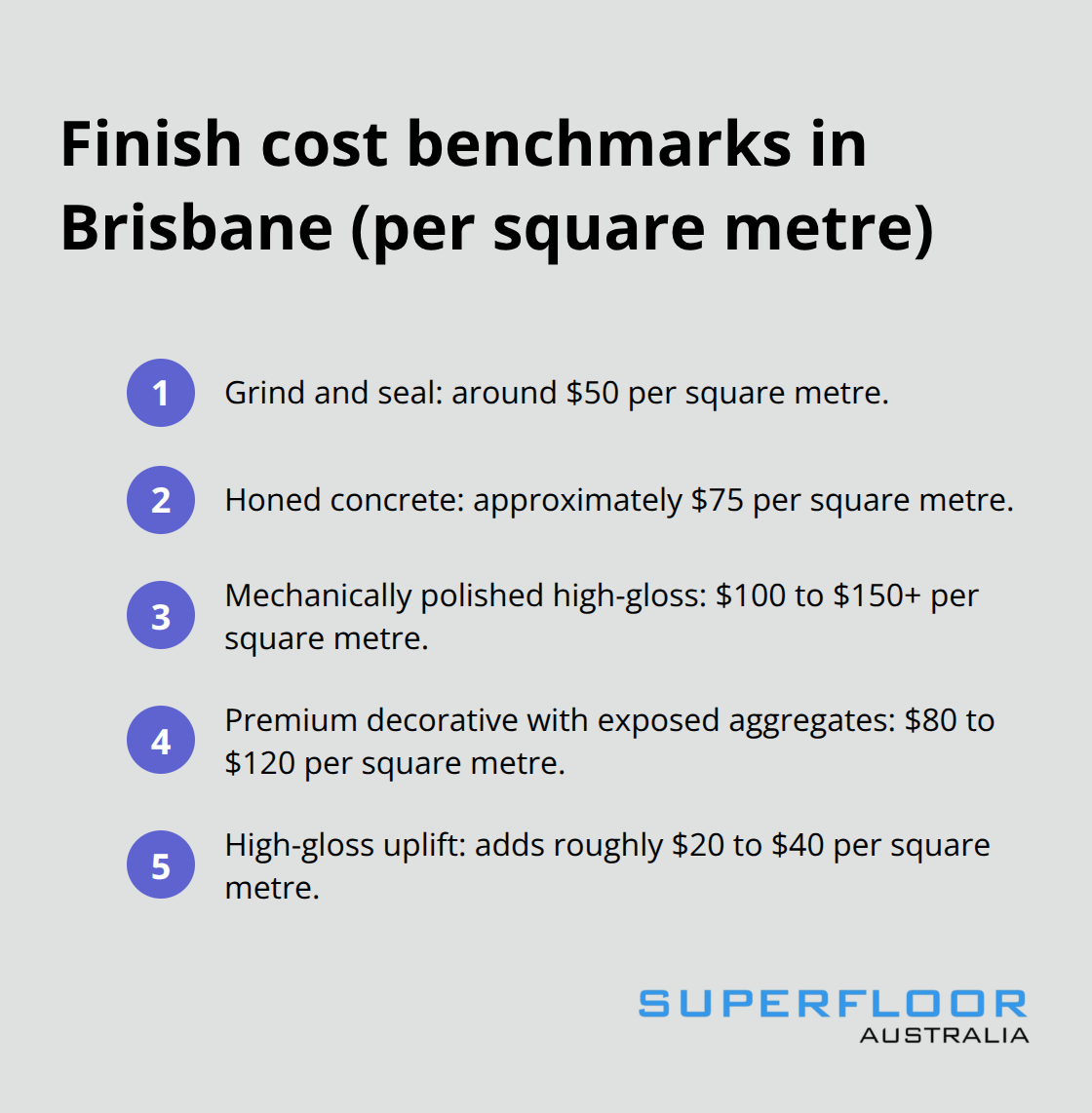
Your finish choice also affects long-term maintenance: grind and seal may need refinishing every 5 to 10 years, whereas honed and polished floors generally last longer and demand less frequent resealing every 2 to 3 years at $8 to $15 per square metre. Understanding these differences helps you weigh upfront costs against future maintenance expenses, which brings us to how material and labour costs actually break down in your final quote.
What Makes Up Your Total Polished Concrete Cost
Sealing Materials Form Your Long-Term Investment
Materials represent only one part of your invoice, and understanding the breakdown prevents budget surprises. Sealing accounts for a significant material expense because quality matters here more than anywhere else. A basic grind and seal uses a single protective layer at around $50 per square metre, but this approach requires reapplication every 5 to 10 years. Premium two-part polyurethane sealers cost more upfront yet last longer and resist stains better. For a 150 square metre home, moving from basic to premium sealing adds roughly $3,000 to $6,000 over the project lifetime when accounting for resealing cycles. The sealant itself costs only $8 to $15 per square metre during maintenance visits, but labour to reapply it doubles your costs. This is why premium sealing on high-traffic areas like kitchens and entryways delivers better value where durability matters most.
Labour Costs Dominate Your Total Invoice
Labour costs consume the largest portion of your total invoice because skilled polishing demands time and precision. Residential projects typically pay premium rates of $75 to $90 per square metre due to access limitations and detailed finish requirements. Waste removal adds $500 to $1,500 unless you provide a skip bin yourself, so coordinate this before work starts. Stain removal and deep scratch repairs add $15 to $25 per square metre because they require extra passes and specialised treatment. Honed concrete costs around $75 per square metre, while mechanically polished concrete-the most expensive option-reaches around $100 per square metre.
Hidden Costs That Catch Property Owners Off Guard
Uneven or cracked concrete can add another 30 percent to your labour estimate when levelling becomes necessary. Generator hire costs $200 to $500 if three-phase power isn’t available on site-a hidden expense many property owners miss. For a realistic timeline, expect 5 to 10 working days for a 150 square metre residential project, though larger commercial spaces over 500 square metres can take 2 to 3 weeks. The key is obtaining a detailed quote that itemises labour hours, materials, waste removal, and any specialty services separately so you understand exactly where your money goes. Once you have these figures in hand, comparing quotes from multiple contractors becomes straightforward-but knowing how to evaluate those quotes fairly requires understanding what separates genuine value from a bargain that costs more later.
How to Evaluate Quotes and Understand True Value
Request Detailed Quotes from Multiple Contractors
Contact three to five local contractors and provide identical project details: exact square meterage, current concrete condition (include photos of cracks or stains), desired finish type, and site accessibility. This forces apples-to-apples comparison rather than vague estimates that shift during the job.
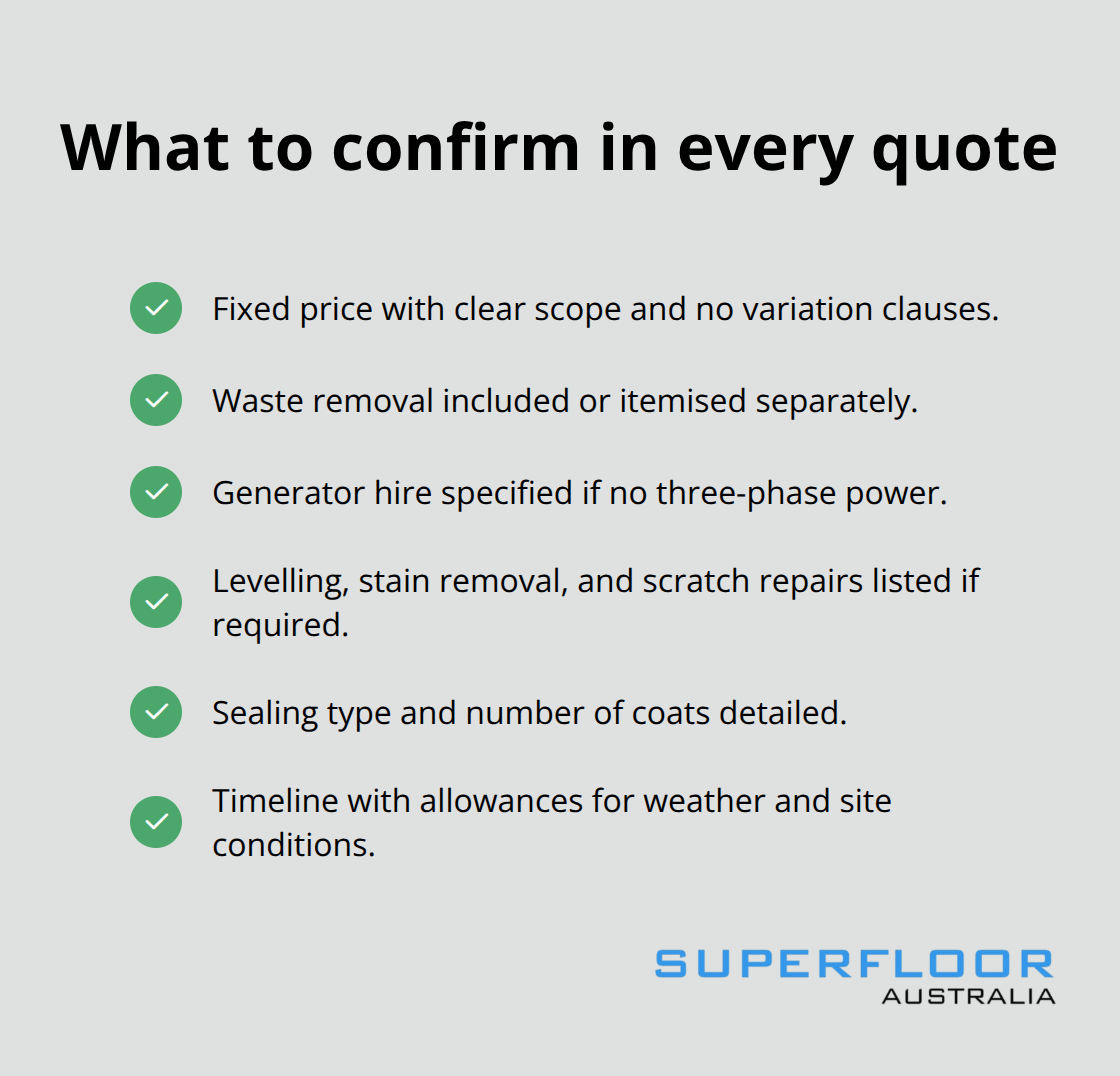
Most contractors will want a site visit anyway, so use that opportunity to ask specific questions about what’s included in their price. Does waste removal get itemised separately? Are they charging for generator hire upfront or adding it later? Will they provide a fixed price with no variation guarantee, or is the quote subject to change once work begins?
A contractor offering fixed pricing with clear scope protection signals confidence in their assessment. Cheaper quotes often omit essential items like levelling, sealing, or waste removal entirely, making direct price comparison meaningless. For instance, a quote at $45 per square metre might exclude sealing, while one at $65 per square metre includes premium two-part polyurethane that lasts years longer.
Understand What Each Quote Actually Includes
Request itemised breakdowns showing labour hours, material costs, and specialty services separately so you understand where your money actually goes. A 150 square metre residential project typically demands 5 to 10 working days, so ask each contractor for their timeline and whether delays due to weather or site conditions will incur extra charges. Superfloor Australia provides free on-site assessments that eliminate guesswork before you commit to any budget figure.
Hidden costs trap property owners who fail to ask the right questions upfront. Generator hire costs $200 to $500 if three-phase power isn’t available on site-a hidden expense many miss. Waste removal adds $500 to $1,500 unless you provide a skip bin yourself, so coordinate this before work starts. Stain removal and deep scratch repairs add $15 to $25 per square metre because they require extra passes and specialised treatment.
Calculate Long-Term Cost of Ownership
Polished concrete floors last 20 to 30 years with proper maintenance, whereas timber requires refinishing every 7 to 10 years, and premium tile installations demand ongoing grout maintenance plus expensive replacement repairs. Polished concrete only needs resealing every 2 to 3 years, making maintenance costs negligible over decades. A mechanically polished high-gloss finish at $100 per square metre on a 150 square metre home costs $15,000 upfront but eliminates flooring replacement for two decades.
Timber at $120 to $200 per square metre would cost $18,000 to $30,000 initially, then require refinishing costs every 7 to 10 years. Over 20 years, timber becomes substantially more expensive when you factor in labour, disruption, and material replacement. Brisbane households also save $200 to $500 annually on heating and cooling with polished concrete versus timber or tile options due to superior thermal mass and reflectivity. Energy savings alone recoup a significant portion of your investment over time.
Compare Value, Not Just Price
The contractor offering the lowest initial price often delivers false economy when maintenance demands and early replacement costs accumulate. Instead, compare total cost of ownership across 20 years, including resealing cycles, potential repairs, and energy efficiency gains. A premium polished finish with quality sealing represents genuine value precisely because it performs for decades without major intervention.
Final Thoughts
Polished concrete Brisbane costs reflect genuine value when you understand what drives pricing and plan accordingly. A mechanically polished high-gloss finish at $100 per square metre on a 150 square metre home costs $15,000 upfront but eliminates flooring replacement for two decades. Compare this against timber at $120 to $200 per square metre requiring refinishing every 7 to 10 years, and polished concrete becomes the smarter long-term investment.
Budgeting wisely means requesting itemised quotes from multiple contractors and understanding what each price includes. Hidden costs like generator hire, waste removal, and stain treatment catch property owners off guard when they skip detailed assessments. A fixed-price quote with clear scope protection signals contractor confidence and protects you from surprise invoices.
The concrete condition assessment determines your foundation budget, accessibility impacts labour costs significantly, and your finish choice drives the largest variation (these three factors control whether your project runs $7,500 or $22,500 for the same square meterage). We at superfloor australia deliver high-quality polished concrete flooring that enhances both aesthetics and durability across homes, commercial, and industrial spaces. Contact superfloor australia for a free on-site assessment that eliminates guesswork before you commit to any budget figure.