

Polished concrete has become the go-to choice for Brisbane builders who want durability without breaking the bank. But understanding the true cost requires more than just looking at installation prices.
At superfloor australia, we’ve helped countless builders navigate a polished concrete cost analysis to make informed decisions. This guide breaks down every expense you need to budget for, from materials to hidden costs that catch most people off guard.
Material and Installation Costs
Polished concrete costs between AUD 50 and AUD 65 per square metre in Brisbane, depending on the finish type and floor condition. For a typical 150 square metre residential space, you’ll pay AUD 7,500 to AUD 9,750 for installation alone. The most affordable option is grind and seal at around AUD 50 per square metre, which applies a non-penetrating sealer and suits budget-conscious builders. Honed concrete sits in the middle at approximately AUD 75 per square metre with better durability than grind and seal because it uses a penetrating sealer. Mechanically polished concrete commands AUD 100 or more per square metre and delivers the highest gloss and longest-lasting finish.
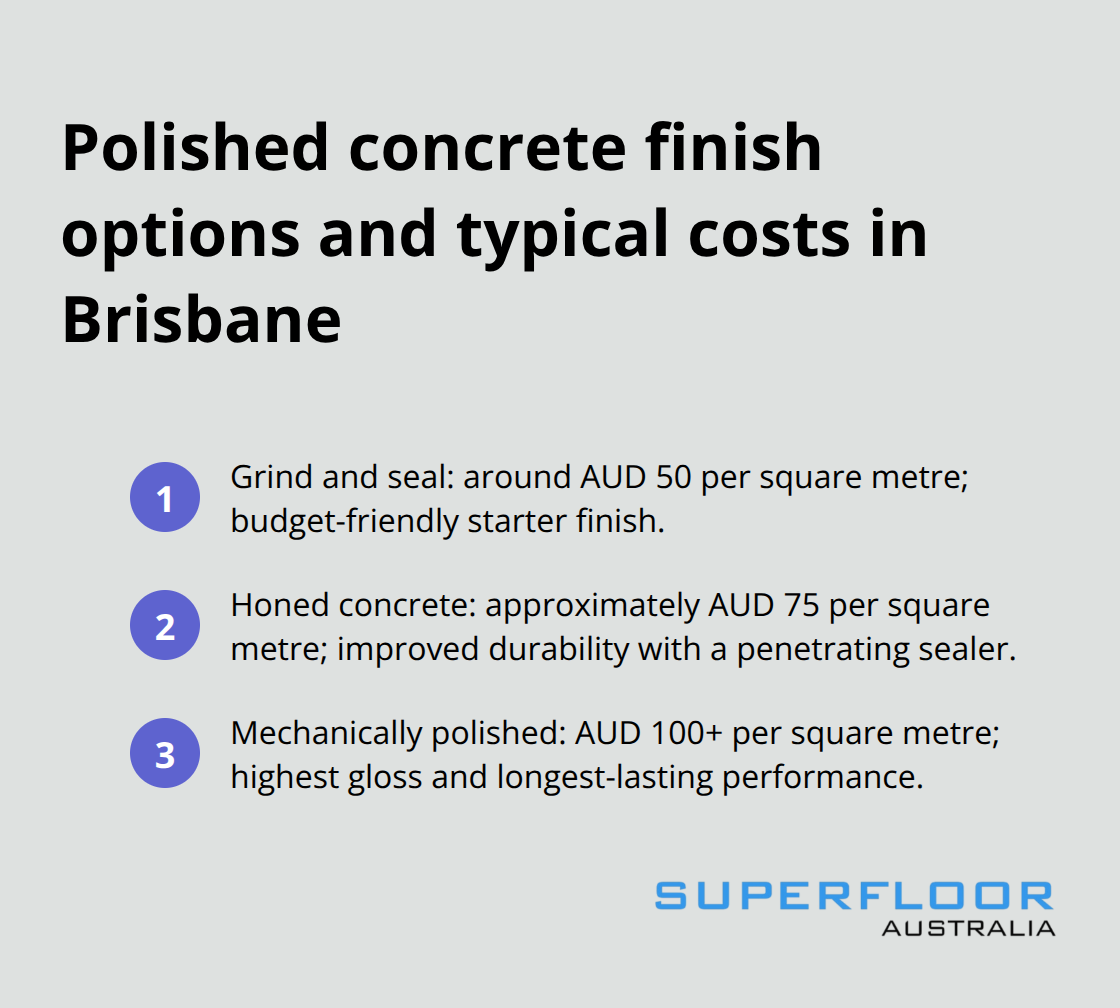
Price Range for Polished Concrete Flooring
Your actual price depends heavily on floor size, existing concrete condition, and finish complexity. Smaller projects under 50 square metres typically cost AUD 75 to AUD 100 per square metre due to setup time, while spaces between 100 and 200 square metres drop to around AUD 50 per square metre. Projects exceeding 200 square metres benefit from economies of scale, falling to AUD 40 to AUD 65 per square metre. A 300 square metre warehouse costs significantly less per square metre than a 50 square metre garage, even though the total bill is higher.
Factors That Influence Material Costs
The condition of your existing concrete is the single largest cost driver after floor size. A crack-free, level slab starts at the lower end of the price range, while extensive repairs add 30 percent to your budget. Oil stains, deep scratches, and uneven sections require extra preparation work that adds AUD 15 to AUD 25 per square metre on top of the base price. An initial site assessment can swing a typical residential budget from approximately AUD 2,500 to AUD 4,000 depending on surface conditions.
Labour costs dominate your budget at 60 to 70 percent of the total, with Brisbane urban areas commanding higher rates than regional Queensland. Material costs such as diamond abrasives and sealants fluctuate with market conditions. Site access matters significantly: ground-level sites attract standard pricing, but upper floors or tight spaces add AUD 10 to AUD 20 per square metre. If your site lacks 3-phase power, generator hire runs AUD 250 to AUD 350 per day, which adds up quickly on multi-day projects. Waste removal costs AUD 500 to AUD 1,500 if you don’t provide your own skip. Complex layouts with numerous small rooms incur additional charges of AUD 5 to AUD 12 per square metre due to extra edge work and repositioning.
Labour Costs and Timeline Expectations
Most residential polishing projects take three to seven days depending on size and finish type. A 150 square metre home typically takes five to seven days for mechanically polished concrete, while grind and seal finishes complete faster at three to five days. Commercial projects over 500 square metres benefit from faster per-square-metre completion rates but take longer overall.
Labour represents the biggest expense in your budget, and timing affects labour costs directly. Peak construction seasons from September to March can raise commercial rates by 15 to 25 percent, so scheduling winter projects saves money. Concrete poured specifically to achieve your desired finish costs less in labour than retrofitting existing slabs because preparation work is minimal. New pours allow you to coordinate polishing before walls and framing go up, which reduces time, labour, and concurrent construction costs significantly.
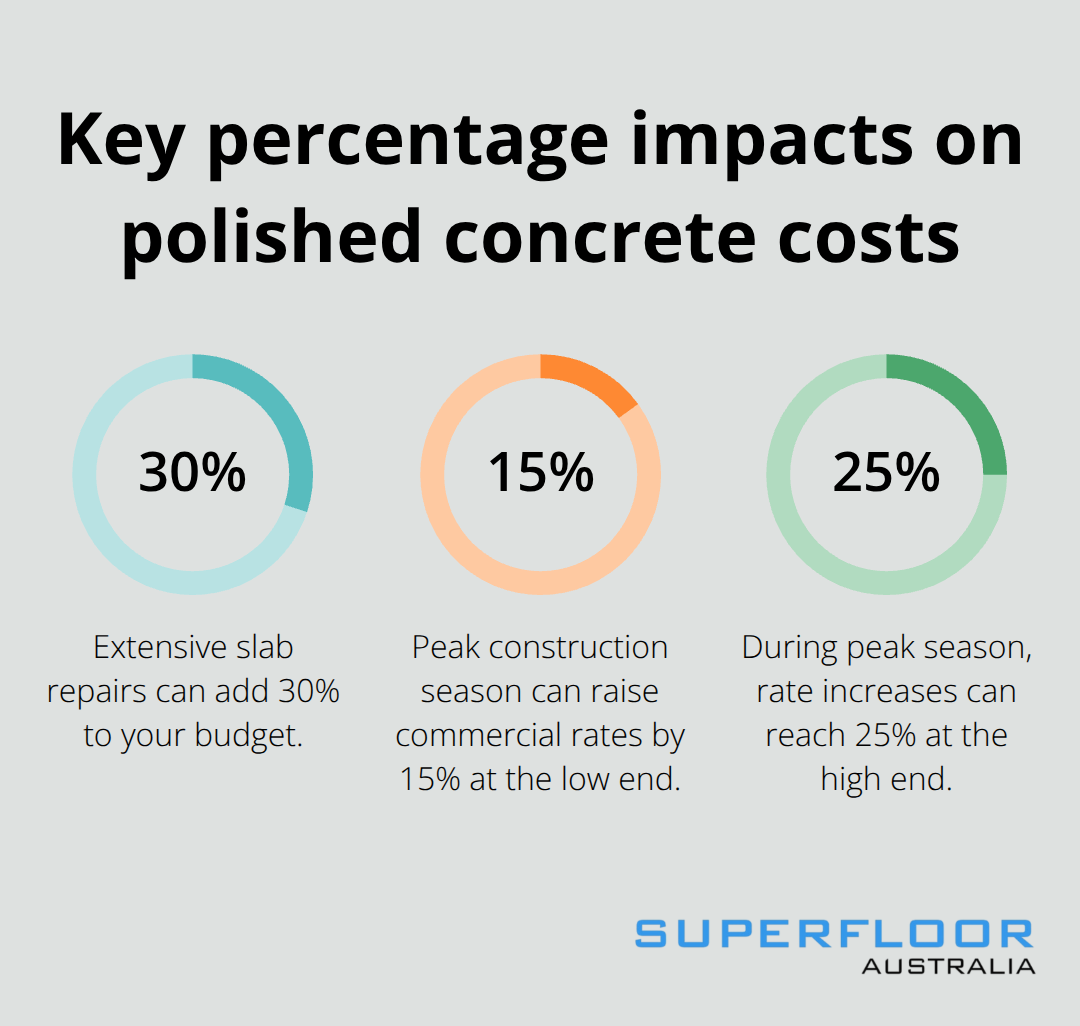
Existing slabs with poor conditions require extensive grinding and repair that extends timelines and multiplies labour expenses.
A site visit is mandatory to provide an accurate quote because variables like moisture levels, slab thickness, and existing coatings dramatically affect labour requirements. These on-site assessments reveal the true scope of work and help contractors calculate realistic timelines and expenses. Understanding these labour dynamics positions you to compare quotes accurately and identify which contractors account for real-world conditions rather than offering unrealistic estimates.
Comparing Polished Concrete to Other Flooring Options
Cost Comparison with Tiles and Timber
Polished concrete outperforms timber and tile on cost from day one, and the gap widens dramatically over two decades. Timber flooring costs AUD 120 to AUD 200 per square metre installed, while premium tile ranges from AUD 80 to AUD 180 per square metre depending on material quality. A 150 square metre residential project runs AUD 18,000 to AUD 30,000 for timber versus AUD 7,500 to AUD 15,000 for polished concrete-a difference of AUD 10,500 to AUD 22,500 before maintenance begins. Tile eliminates some initial cost savings because grout lines demand constant cleaning and grout deterioration within 10 years requires expensive regrouting. Polished concrete offers no grout maintenance, no joint failures, and no seams that trap dirt and bacteria.
Maintenance Expenses Over Time
Timber refinishing costs AUD 25 to AUD 40 per square metre every 7 to 10 years, which for a 150 square metre floor runs AUD 3,750 to AUD 6,000 per refinish cycle. Water damage represents another hidden timber expense-a single incident costs AUD 500 to AUD 2,000 in repairs and replacement, while polished concrete resists moisture and can be restored from minor damage with targeted repolishing rather than wholesale replacement. Tile’s porosity and grout vulnerability make it susceptible to moisture penetration and staining in high-humidity environments like Brisbane.
Long-Term Value and Durability Benefits
Over a 20-year horizon, polished concrete costs approximately AUD 65 to AUD 115 per square metre including installation and maintenance, factoring in resealing every 2 to 3 years at AUD 8 to AUD 15 per square metre. Brisbane builders gain additional savings through energy efficiency-polished concrete’s thermal mass regulates indoor temperatures, reducing heating and cooling costs by AUD 200 to AUD 500 annually depending on climate and building design. Polished concrete floors last 20 to 30 years with minimal major renovations when properly sealed and maintained, whereas timber typically requires complete refinishing within 15 to 20 years and tile grout fails within 10 to 15 years.
Performance in High-Traffic Environments
The durability advantage matters most in commercial spaces where foot traffic is heavy. Mechanically polished concrete withstands constant use without visible wear, while timber shows scratches and tile grout crumbles under commercial loads. Timber flooring degrades faster in Brisbane’s humid subtropical climate, requiring more frequent refinishing and replacement. For Brisbane builders managing multiple projects, polished concrete’s predictable maintenance schedule and lower total cost of ownership make budgeting straightforward and profit margins more reliable than alternatives.
Planning Your Next Project
These cost comparisons reveal why polished concrete dominates Brisbane’s commercial and residential sectors. The initial savings compound over time, and the durability advantage protects your investment through decades of use. Understanding these financial realities positions you to make confident decisions about flooring specifications. The next step involves identifying the hidden costs that most builders overlook-expenses that can shift your entire budget if you don’t plan ahead.
Hidden Costs and Budget Considerations
Site Preparation and Concrete Repair
Concrete repair and surface preparation consume far more budget than most builders anticipate, and underestimating this work tanks project profitability. Moisture testing costs AUD 4 to AUD 7 per square foot, and if moisture levels exceed acceptable thresholds, mitigation systems run AUD 10 to AUD 25 per square metre to prevent sealer failure and floor deterioration. Cracks wider than 3mm require injection or routing before polishing can begin, adding AUD 15 to AUD 25 per square metre depending on crack density and depth.
Oil stains, paint residue, and chemical contamination demand aggressive grinding to remove, which extends labour time and adds grinding costs that compound quickly across large areas. A 200 square metre warehouse with moderate oil staining and three significant cracks easily absorbs an extra AUD 3,000 to AUD 5,000 in prep work alone. If the existing concrete is severely damaged with extensive pitting or spalling, a concrete overlay resurfacing at AUD 50 to AUD 65 per square metre becomes necessary before polishing can occur, essentially doubling your total cost.
Site assessments reveal these conditions early and prevent budget shock during construction. Many builders skip the assessment fee (around AUD 75) and regret it when unexpected repairs emerge mid-project and blow timelines apart.
Sealing and Protection Treatments
Sealing and protection treatments represent ongoing expenses that builders frequently omit from long-term budgets, yet they determine whether your polished floor survives its warranty period intact. Initial sealing during installation costs AUD 5 to AUD 15 per square metre depending on sealer quality and application method, but resealing every 2 to 5 years at AUD 3 to AUD 8 per square metre keeps the finish protected from moisture infiltration and staining.
High-traffic commercial floors need resealing every 2 years, while residential spaces with moderate foot traffic stretch to 4 or 5 years. Brisbane’s subtropical humidity accelerates sealer degradation, particularly in spaces near windows or with poor ventilation, so factor in more frequent resealing cycles than southern Australian projects. Non-slip additives to sealers cost an extra AUD 3 to AUD 5 per square metre but are essential for wet areas, kitchens, and commercial environments where slip liability matters.
Repolishing every 5 to 10 years at AUD 10 to AUD 20 per square metre restores gloss and removes minor scratches before they become permanent damage. A 150 square metre residential floor will cost AUD 450 to AUD 1,200 over 20 years in resealing and repolishing alone, which many builders fail to communicate to clients upfront.
Additional Expenses to Plan For
Generator hire costs AUD 250 to AUD 350 per day if your site lacks 3-phase power with a 5-pin outlet, and multi-day projects accumulate AUD 1,000 to AUD 1,200 in equipment costs quickly. Waste removal fees of AUD 500 to AUD 1,500 apply if you don’t arrange skip bins yourself, and complex floor layouts with numerous small rooms add AUD 5 to AUD 12 per square metre in extra handwork that disrupts your per-square-metre pricing calculations.
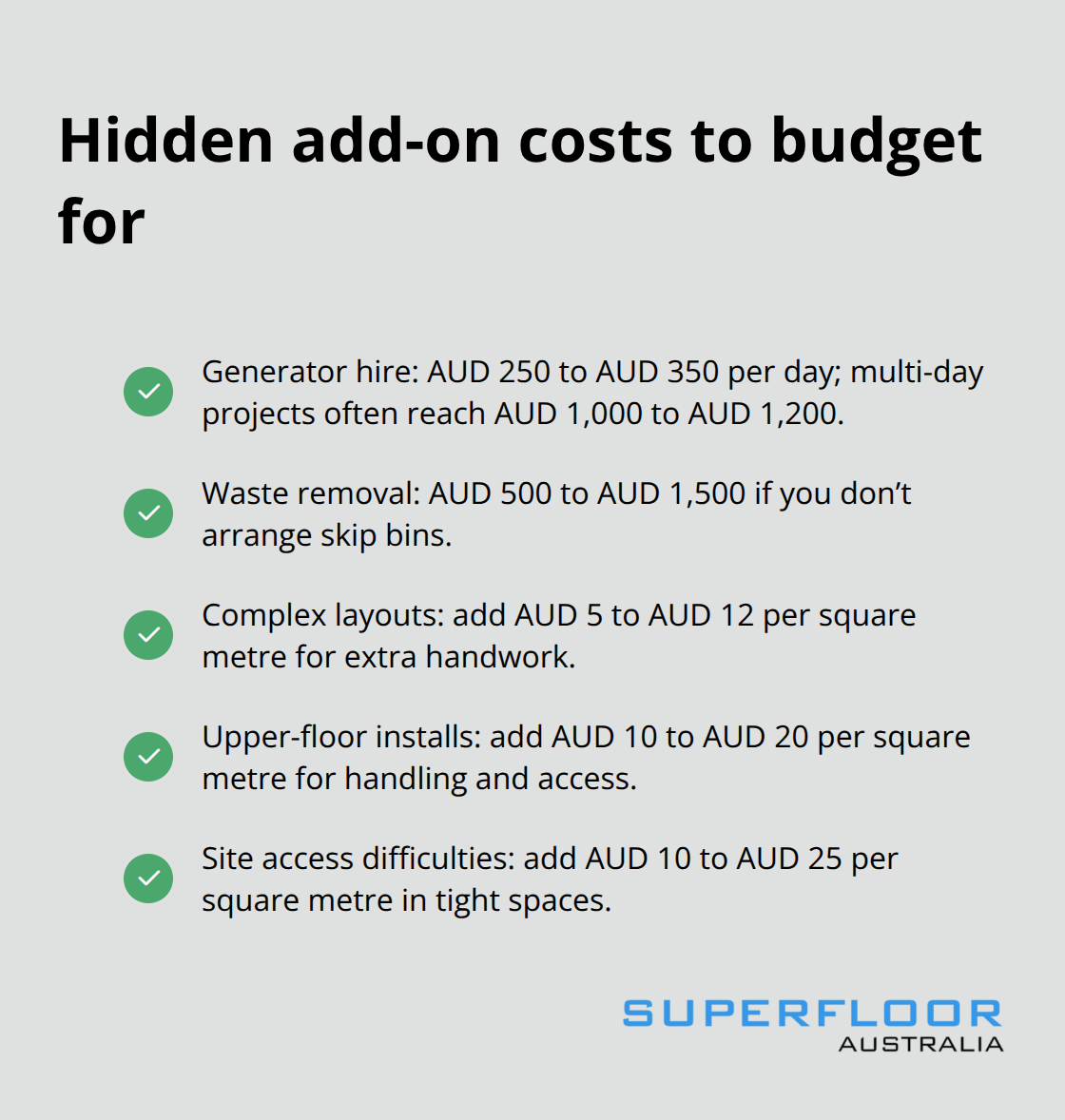
Upper-floor installations add AUD 10 to AUD 20 per square metre because equipment must be carried up stairs or hoisted, and site access difficulties add another AUD 10 to AUD 25 per square metre when tight spaces limit machinery movement. These variables stack on top of each other, transforming a straightforward AUD 50 per square metre quote into a AUD 85 to AUD 110 per square metre reality on complex projects.
Final Thoughts
Polished concrete cost analysis reveals a straightforward financial reality: Brisbane builders gain significant advantages by choosing polished concrete over timber and tile. The initial investment of AUD 50 to AUD 65 per square metre appears modest until you factor in long-term maintenance, replacement cycles, and durability. Over 20 years, polished concrete costs AUD 65 to AUD 115 per square metre total, while timber demands complete refinishing every 7 to 10 years and tile grout fails within a decade.
Budget planning requires you to account for hidden costs that separate realistic quotes from optimistic estimates. Site preparation, moisture testing, crack repair, and sealing treatments add AUD 15 to AUD 25 per square metre on damaged slabs, while generator hire, waste removal, and complex layouts stack additional expenses that transform a AUD 50 per square metre base price into AUD 85 to AUD 110 per square metre on challenging projects. Communicating these variables to clients upfront prevents budget shock and protects your profit margins.
Return on investment materialises through reduced maintenance expenses, predictable resealing schedules every 2 to 5 years, and floors that perform reliably for 20 to 30 years. Contact Superfloor Australia to transform your next Brisbane project with flooring that combines cost efficiency with exceptional performance.