

Your pool deck needs to handle wet feet, intense Brisbane sun, and constant use without becoming a safety hazard. Standard concrete cracks, tiles become slippery, and pavers shift-leaving you with expensive repairs and liability concerns.
At superfloor australia, we’ve helped Brisbane homeowners transform their pools with poolside concrete finishes that combine safety, style, and durability. This guide shows you why honed concrete outperforms other options and how to design a deck that looks great for decades.
Why Poolside Concrete Matters in Brisbane
Wet outdoor areas around pools cause injuries annually across Brisbane, and property owners face real liability when accidents happen. Standard pool decking fails because polished concrete becomes dangerously slippery when wet-essentially a skating rink during the wet season when rainfall intensifies. Tiles crack from thermal stress as Brisbane’s sun heats surfaces to over 60°C, and pavers shift under water pressure, creating trip hazards that compound your maintenance costs.
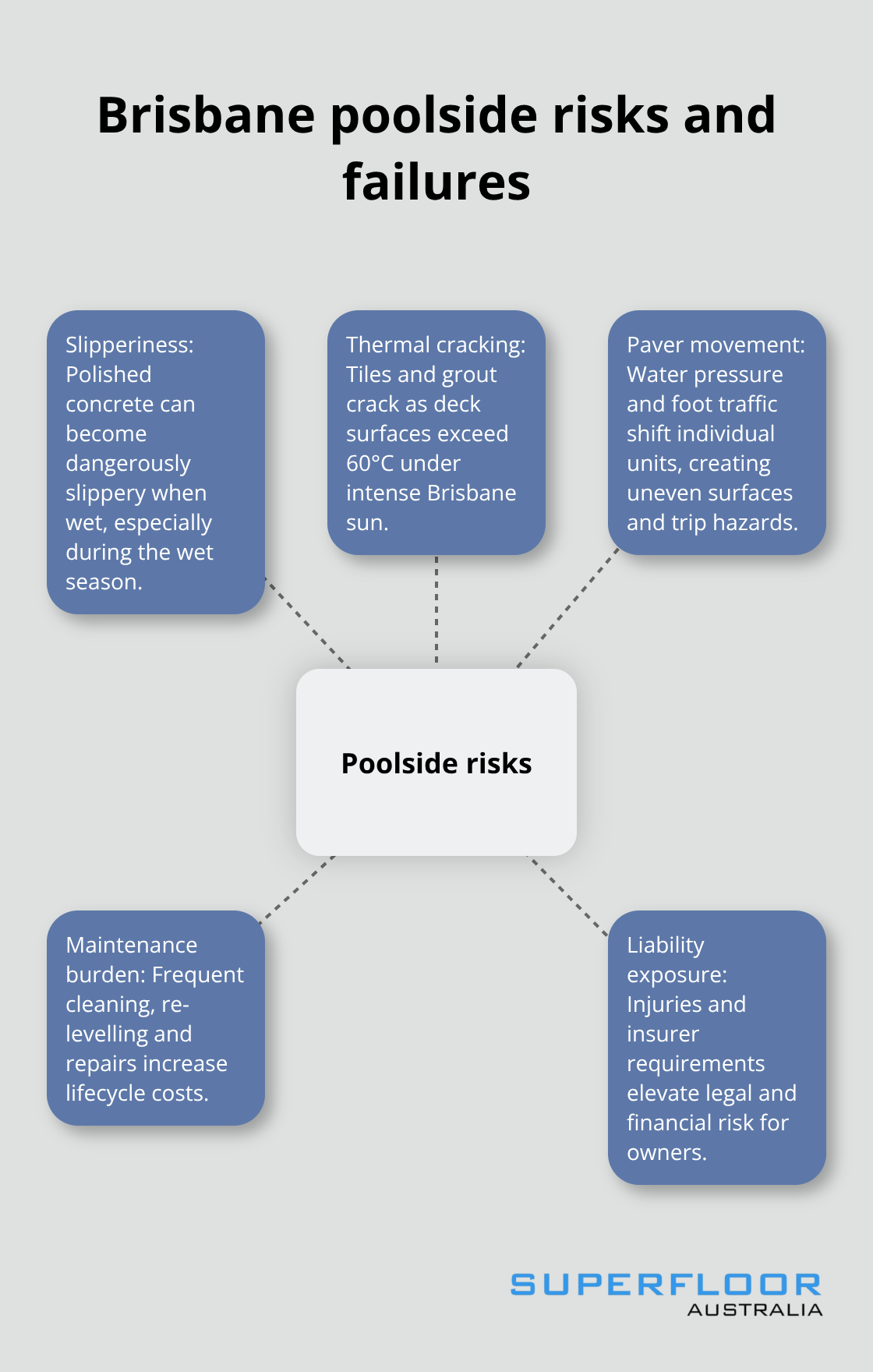
Insurance companies take pool safety seriously; some insurers now require slip-resistant finishes on pool surrounds, and slip-and-fall claims typically settle out of court within 6 to 12 months, meaning your liability exposure is substantial.
Meeting Safety Standards That Protect Your Family
The Australian Standard AS 4586 sets specific slip-resistance ratings for wet areas, with P4 and P5 ratings required for pool decks. A concrete pool surround with proper slip-resistance meets these standards and protects your family while reducing your legal exposure. Honed concrete resists UV damage, chlorine, and salt exposure-critical for Brisbane’s intense sun and coastal salt spray. Unlike tiles that stain and pavers that trap water, a sealed concrete finish sheds moisture and prevents pooling that creates slippery patches.
Durability That Lasts Two Decades
Concrete pool surrounds last 20 years or longer with minimal maintenance, significantly outperforming timber decks that rot and pavers that require constant releveling. Material costs run around $100 per square metre for standard concrete, with exposed aggregate finishes between $125 and $160 per square metre, making concrete far cheaper than replacing timber or pavers every 5 to 10 years. Installation typically takes 1 to 3 days depending on your project scope, so you avoid disrupting your summer entertaining schedule for weeks.
Design Flexibility and Long-Term Appeal
A well-executed pool surround adds measurable curb appeal and increases property value by improving both aesthetics and safety. Coloured concrete and honed finishes enable you to match your home’s architectural style, whether you prefer modern, coastal, or classic designs. Lighter finishes and white cement blends keep surfaces cooler in direct sun, making barefoot comfort a genuine benefit rather than an afterthought. Concrete accepts decorative patterns, inlays, and custom colours that resist fading from UV and chlorine, giving you design flexibility that tiles and pavers cannot match without constant maintenance.
The low-maintenance reality means no pressure washing every season, no grout sealing, and no loose aggregate issues-just occasional resealing every 2 to 3 years to maintain grip and UV protection. This durability and ease of care set the stage for understanding how honed concrete specifically compares to other poolside flooring options available to Brisbane homeowners.
Honed Concrete Beats Tiles and Pavers for Pool Decks
Why Tiles Fail in Brisbane’s Climate
Tiles crack under thermal stress because Brisbane’s intense sun heats pool deck surfaces to over 60°C, and repeated expansion and contraction fractures grout lines within months. Water penetrates underneath when tiles crack, destabilizing the base and creating soft spots that shift under foot traffic. You face permanent staining on tile surfaces, and grout lines degrade within 3 to 5 years from UV damage, chlorine, and salt exposure that bleach and discolour the finish. Pressure washing becomes a regular chore to remove algae and mould that accumulate in grout joints, yet the stains often remain permanent.
The Problem with Pavers
Pavers trap moisture between units, and Brisbane’s wet season pushes water up through the base, causing pavers to heave and settle unevenly. Trip hazards worsen each season as the base fails, and the cost to re-level or replace sections runs $150 to $250 per square metre depending on damage extent. Releveling becomes necessary every 5 to 7 years, and complete replacement occurs within 15 to 20 years as structural failure accelerates. The individual units shift independently, creating an unstable surface that demands constant attention.
How Honed Concrete Solves These Problems
Honed concrete eliminates these issues because the surface is monolithic-no grout lines to crack, no individual units to shift. Water sheds across a properly sloped and sealed concrete surface rather than pooling between tiles or pavers. The finish resists UV damage, chlorine, and salt exposure that compromise other materials. Unlike tiles and pavers, honed concrete maintains its appearance with minimal intervention and resealing every 2 to 3 years.
Long-Term Cost Comparison
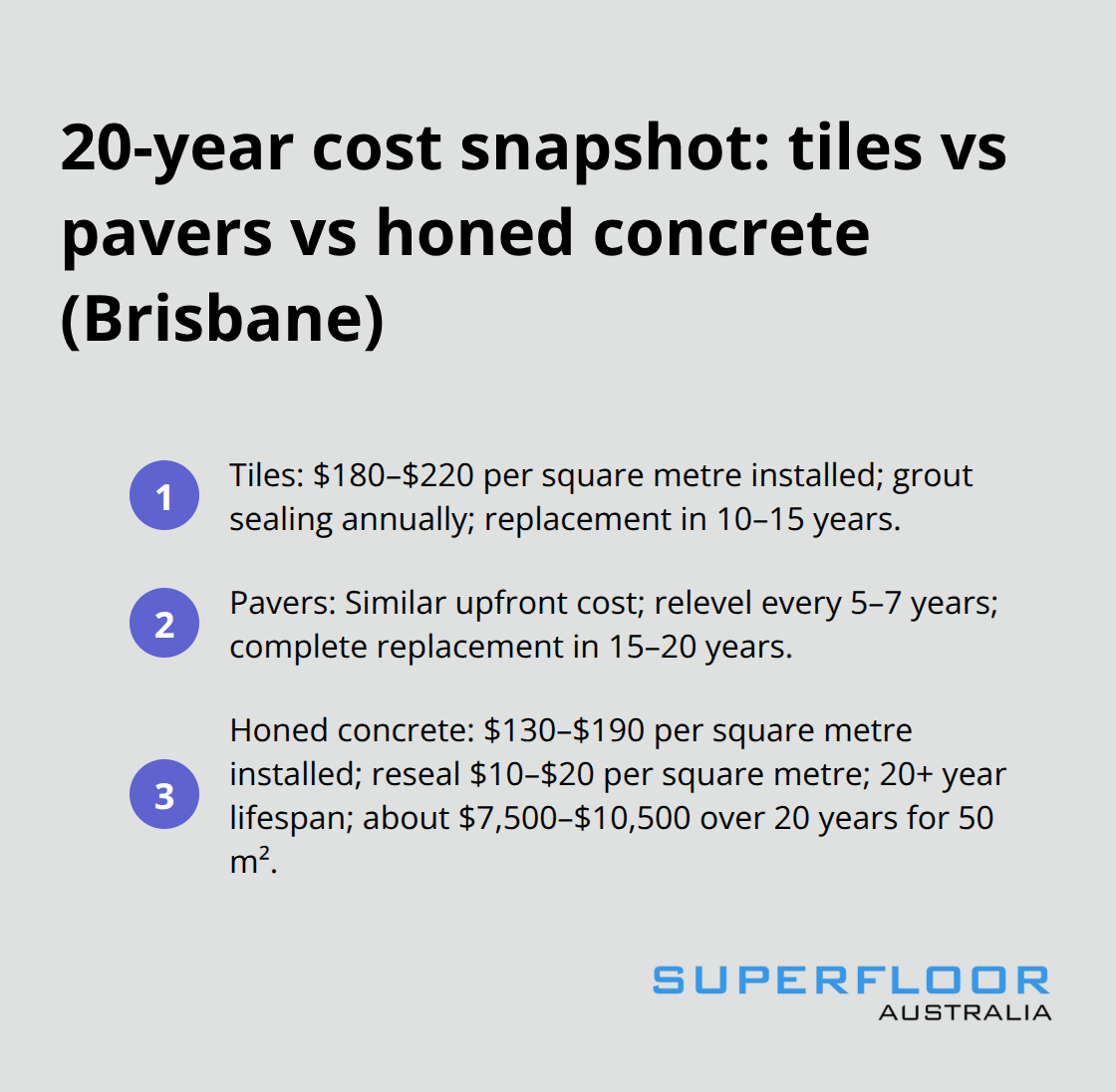
Tiles installed at $180 to $220 per square metre require grout sealing annually and tile replacement every 10 to 15 years as cracks spread and underlying damage accumulates. Pavers at similar upfront cost demand releveling every 5 to 7 years and complete replacement within 15 to 20 years. Honed concrete costs $130 to $190 per square metre installed and lasts 20 years or longer with only periodic resealing at $10 to $20 per square metre. Over a 20-year period on a 50-square-metre pool deck, tiles cost approximately $18,000 to $22,000 including maintenance and replacement, while honed concrete totals roughly $7,500 to $10,500.
Temperature and Comfort Benefits
Honed finishes keep surfaces cooler than dark tiles because lighter cement blends and white aggregates reflect heat rather than absorb it. Barefoot comfort improves significantly, and the surrounding pool area stays cooler during Brisbane’s hot months. Property buyers in Brisbane recognise concrete pool surrounds as a smart investment, which is why homes with professionally finished concrete decks command higher resale value than those with aging tile or paver surrounds. This financial advantage makes the choice clear when you consider both immediate performance and future property appeal.
Understanding the performance advantages of honed concrete sets the foundation for exploring how to design your poolside space to maximise both safety and visual impact.
Designing Your Poolside with Honed Concrete
Honed concrete offers genuine design freedom because the surface accepts colour, texture, and pattern without compromising slip resistance or durability. The finish starts with a ground assessment that determines soil stability, drainage patterns, and foundation requirements before any concrete touches the ground. Soil testing using methods like Atterberg Limits and Moisture Content analysis prevents future settling that cracks pool decks and creates trip hazards.
Foundation and Drainage Planning
Drainage planning matters more than most homeowners realise; water must flow away from the pool at roughly 0.25 inches per foot, with perimeter or French drains handling poor natural drainage so standing water never pools on your deck. A compacted 4 to 6 inch crushed stone base supports the concrete layer, and the concrete itself must meet AS 3600-2018 standards for residential use. Reinforcement using 6×6 welded wire mesh (10/10) prevents cracking from thermal movement and foot traffic, while commercial spaces may need heavier rebar in a grid pattern.
Installation takes 1 to 3 days depending on your project scope, and proper curing for at least seven days before sealing ensures the surface reaches full strength and grip. The concrete pours in a single continuous pour to avoid weak joints, and the contractor must level the surface precisely to prevent water pooling in low spots.
Slip Resistance That Meets Australian Standards
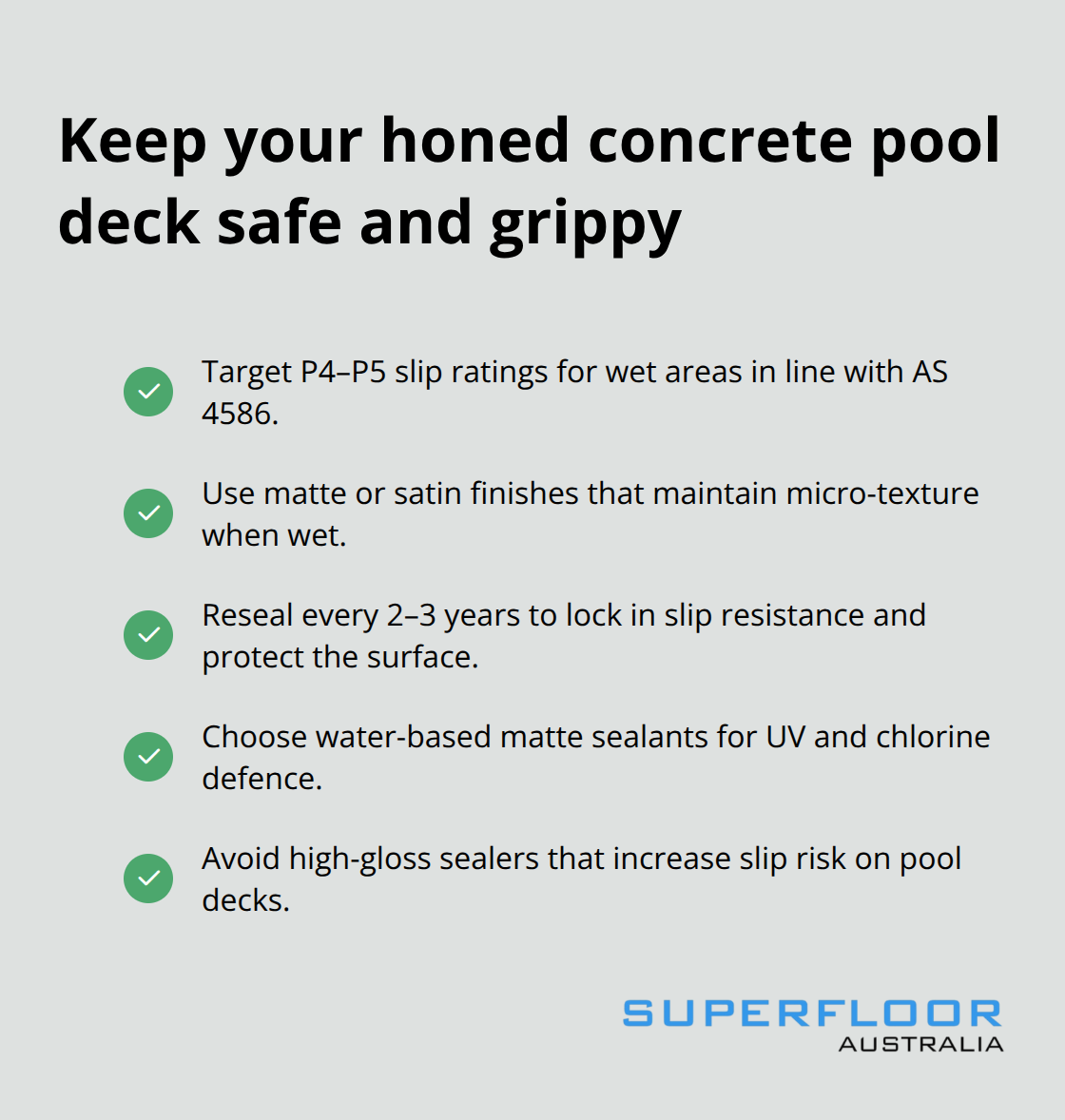
AS 4586 specifies P4 and P5 slip-resistance ratings for wet areas, and honed concrete achieves these standards through surface texture and proper sealing. The matte or satin finish of honed concrete naturally resists slipperiness because the grinding process creates micro-texture that maintains grip even when wet, unlike polished finishes that become skating rinks during Brisbane’s wet season. Sealing the surface every 2 to 3 years locks in slip resistance and protects against moisture penetration that degrades concrete and accelerates staining.
Water-based matte sealants preserve grip while protecting against UV damage and chlorine degradation, and you should avoid high-gloss sealers on pool decks because glossy finishes increase slip risk. Lighter colours and white cement blends reduce surface temperature by 10 to 15 degrees compared to dark finishes, making barefoot comfort genuine rather than theoretical.
A 50-square-metre pool deck in a lighter honed finish costs between $6,500 and $9,500 installed, with maintenance costs of roughly $100 to $200 every 2 to 3 years for resealing.
Colour and Pattern Selection for Your Home
Honed concrete accepts water-based stains and colour enhancements that resist fading from UV and chlorine, so your deck maintains its appearance without seasonal touch-ups. Exposed aggregate finishes reveal small stones in the concrete surface, adding visual texture and maximum grip on high-traffic areas, though installation at $125 to $160 per square metre costs more than plain honed finishes at $50 to $100 per square metre. Stamped concrete patterns that mimic slate, cobblestone, or timber combine with non-slip coatings and water-based colour stains, running $180 to $220 per square metre installed.
Darker colours absorb more heat and become uncomfortable underfoot during Brisbane summers, so lighter tones, grays, and whites remain the practical choice for pool areas where barefoot use is constant. Decorative inlays and custom patterns are possible, but simplicity often wins because complex patterns can trap debris in crevices and complicate cleaning. Coordinate your finish colour with your home’s architectural style; modern homes suit sleek honed gray, coastal properties work with lighter sand tones, and classic designs pair well with warm cream or beige honed concrete.
Final Thoughts
Honed concrete stands out as the practical choice for Brisbane pool surrounds because it delivers slip resistance, durability, and visual appeal without the maintenance burden of tiles or pavers. Over 20 years, a honed concrete deck costs significantly less than replacing tiles every 10 to 15 years or releveling pavers every 5 to 7 years. The surface resists UV damage, chlorine, and salt exposure that compromise other materials, and lighter finishes keep your deck comfortable underfoot during Brisbane’s hot months.
Starting your poolside concrete finishes Brisbane renovation begins with a site assessment that evaluates soil stability, drainage patterns, and foundation requirements. Proper ground preparation using compacted crushed stone and reinforced concrete meeting AS 3600-2018 standards prevents settling and cracking that creates safety hazards. Installation typically takes 1 to 3 days, so you avoid disrupting your summer entertaining for weeks.
We at superfloor australia bring 30 years of Brisbane experience to every poolside project, delivering precision preparation and expert craftsmanship that ensures lasting results. Our team specialises in outdoor honed concrete solutions that provide slip-resistant elegance for pool areas, and we tailor each project to your specific needs and budget. Contact superfloor australia today for a free, no-obligation quote and start planning the poolside deck that will serve your family safely and beautifully for decades.